Monuments
Church of Vila Boa de Quires
Church of Vila Boa de Quires (Saint Andrew), in Marco de Canaveses: 13th-century Romanesque, portal with bovine-head corbels and National Monument since 1927.
- Location
- Vila Boa de Quires, Marco de Canaveses, Porto
- Built
- Século XIII (2.º quartel ou meados); fachada deslocada e torre em 1881
The Church of Vila Boa de Quires, also called the Church of Santo André, stands in the parish of Vila Boa de Quires e Maureles, in the municipality of Marco de Canaveses, on the left bank of the Tâmega. It is one of the Romanesque churches of the Lower Tâmega and is part of the Rota do Românico. Visitors see above all a richly worked granite portal, set into a façade that, as will be seen, is not where it originally stood.
A monastery before the church
The Rota do Românico, which publishes the chronology of the monument, suggests a possible foundation of the monastic house of Vila Boa de Quires in the 11th century and a first documentary reference in 1118, to the «monasterium que dicent Villa Bona de Queiriz». In the 13th century the place appears as a couto (jurisdictional domain) associated with the honours of Portocarreiro and Buriz, indicating a seigneurial lordship of local and regional weight.
The Romanesque building that survives today was built, according to the same source, in the second quarter or middle of the 13th century, as part of a monastic complex. Secularisation is placed in 1320 and, in 1536, Vila Boa de Quires became a commandery of the House of Bragança. The Rota also mentions a date of 1180, allegedly read from an inscription found during the works of 1881; this should be treated with caution, since the source itself presents it as supposed.
The façade and portal
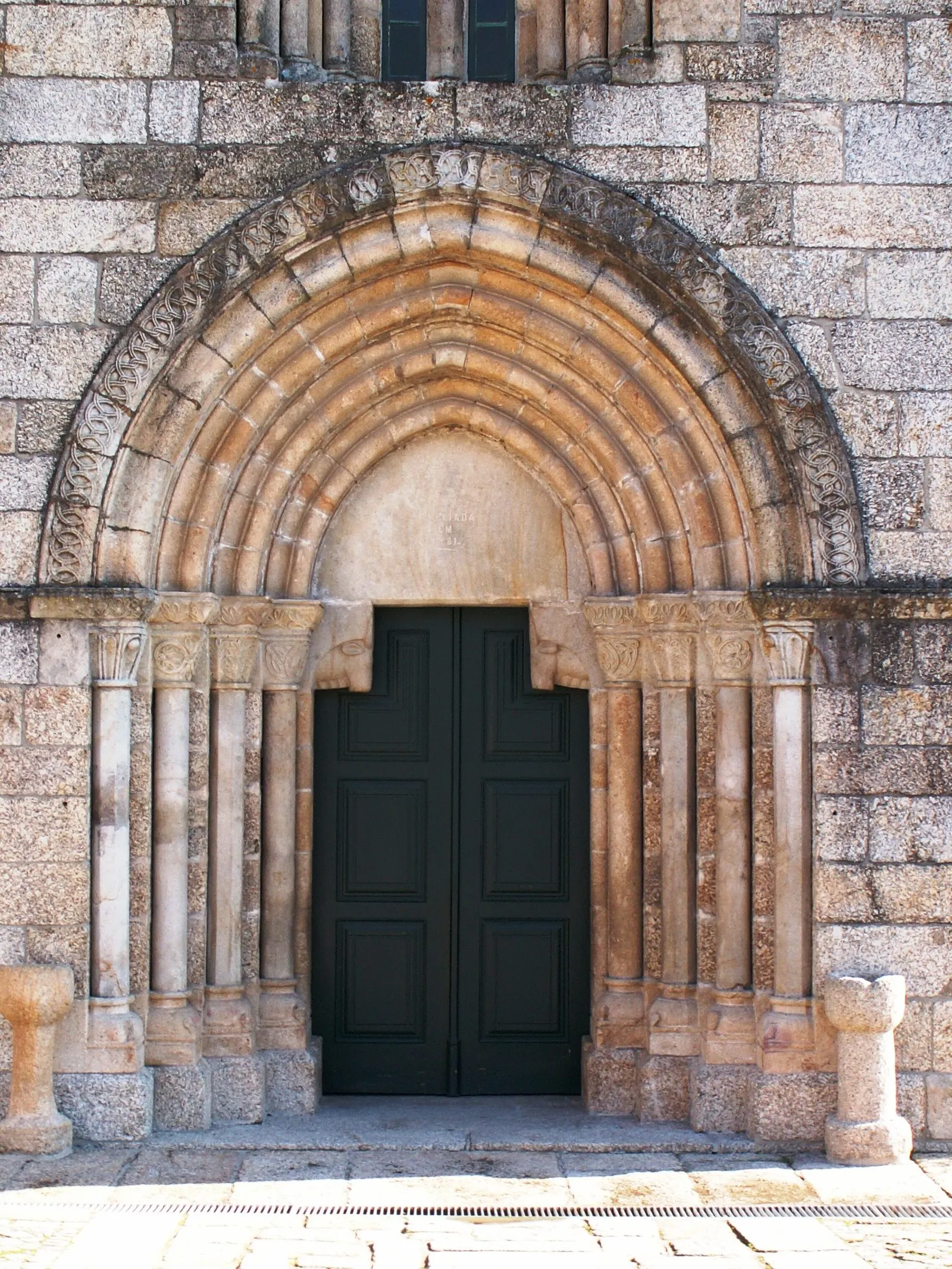
The main façade is described by the Rota as one of the most elaborate in the Lower Tâmega, comparable to that of the church of Barrô, in Resende. The portal recalls that of the monastery of Paço de Sousa, in Penafiel, with capitals decorated with symmetrical vegetal motifs, and the corbels take the form of bulls’ heads, a detail the Rota even uses as a question in its digital passport.
There is an important nuance: the whole façade was moved in 1881, when the nave was enlarged. In that work the front of the church was set back about ten metres westward and the bell tower was built. In other words, the portal is medieval, but its relationship with the body of the church results from a nineteenth-century intervention. The photograph illustrating this page shows precisely this portal.
The interior
Inside, the church contrasts with the sobriety of its exterior. The most marked artistic differences lie in the chancel. The high altarpiece is Neoclassical, with a large canvas depicting the Adoration of the Blessed Sacrament, and it replaced, in the last quarter of the 19th century, an earlier altarpiece of Baroque design. On the vault of the chancel, a campaign of painting from the second half of the 18th century depicts scenes of the Last Judgement and the Passion of Christ, and the sequence ends with the mural painting of the triumphal arch, in the nave. The Rota’s chronology also records a campaign of azulejos in the chancel in the first half of the 17th century and, in 1977, the removal of the render from the naves and ceiling, which left the granite exposed.
Classification and protection
The church is a National Monument under Decree No. 14 425, of 15 October 1927 (Diário do Governo, I series, No. 228), under the designation «Igreja de Vila Boa de Quires». The Atlas do Património Classificado also lists, in the same parish, the «Casa inacabada de Vila Boa de Quires, mais conhecida por Obras do Fidalgo», classified as a Property of Public Interest; this text does not describe it, as we have not consulted a primary source for it. The church is not part of any UNESCO inscription. The Atlas does not indicate a special protection zone for this monument.
The Rota do Românico refers to conservation interventions throughout the 20th century, with particular attention to the roofs (between 1940 and 1970, and again in 1999), the integration of the monument into the Rota in 2010, and general conservation works in 2013, mainly on the roofs and external walls.
Planning a visit
At the consultation of 5 November 2026, the Rota do Românico page indicated visits by appointment, with celebrations on Saturdays at 4 p.m. and Sundays at 9 a.m., and gave accessibility for persons with reduced mobility as «total or partial». Appointments are made through the Rota’s contacts (+351 255 810 706 or +351 918 116 488, and [email protected]). The address given is Rua de Santo André, Vila Boa de Quires. Check the conditions on the Rota do Românico website before travelling.
In the same municipality, the Rota also includes the Church of Vila Boa do Bispo and the Church of Santo Isidoro. For the stylistic context, see Romanesque architecture in Portugal and the parish churches.
Photograph by Pedro from Maia (Porto), Portugal, dated 10 January 2009. Original on Wikimedia Commons, under CC BY 2.0; resized and compressed for the web, without altering the composition.
Frequently asked questions
- When was the church built?
- The Rota do Românico dates the present Romanesque building to the second quarter or middle of the 13th century, as part of a monastic complex. It also refers to a monastery («monasterium que dicent Villa Bona de Queiriz») already in 1118, and to a date of 1180, allegedly carved on an inscription found during the works of 1881.
- What changed in 1881?
- The nave was enlarged: according to the Rota do Românico, the main façade was moved about 10 metres westward and the bell tower was built. The portal seen today was therefore relocated.
- What is its classification?
- National Monument, by Decree No. 14 425, published in the Diário do Governo, I series, No. 228, of 15 October 1927, under the designation «Igreja de Vila Boa de Quires», also known as the Church of Santo André. It is not part of any UNESCO inscription.
- Can I visit the interior?
- At the consultation of 5 November 2026, the Rota do Românico indicated visits by appointment and celebrations on Saturdays at 4 p.m. and Sundays at 9 a.m. Always confirm with the Rota before travelling.
Sources
- Património Cultural, I.P. — Atlas do Património Classificado e em Vias de Classificação (NINV 3645)
- Diário do Governo — Decreto n.º 14 425, de 15 de outubro de 1927 (I série, n.º 228)
- Rota do Românico — Igreja de Santo André de Vila Boa de Quires
- Rota do Românico — Roteiro: Igreja de Quires (guia em PDF)
- Wikidata — Igreja de Santo André (Q10300684)
Keep exploring
Heritage nearby
More places to discover from here. Approximate straight-line distances, within 50 km.