Monuments
Parish Church of Atouguia da Baleia (São Leonardo)
Igreja de São Leonardo, Atouguia da Baleia's parish church in Peniche: Romanesque-Gothic, with debated dating, a portal, tombs and 16th-century painting.
- Location
- Atouguia da Baleia, Peniche, Leiria
- Built
- Datação debatida, entre finais do séc. XII e inícios do XIV; coro dos anos 1460; portal da sacristia manuelino
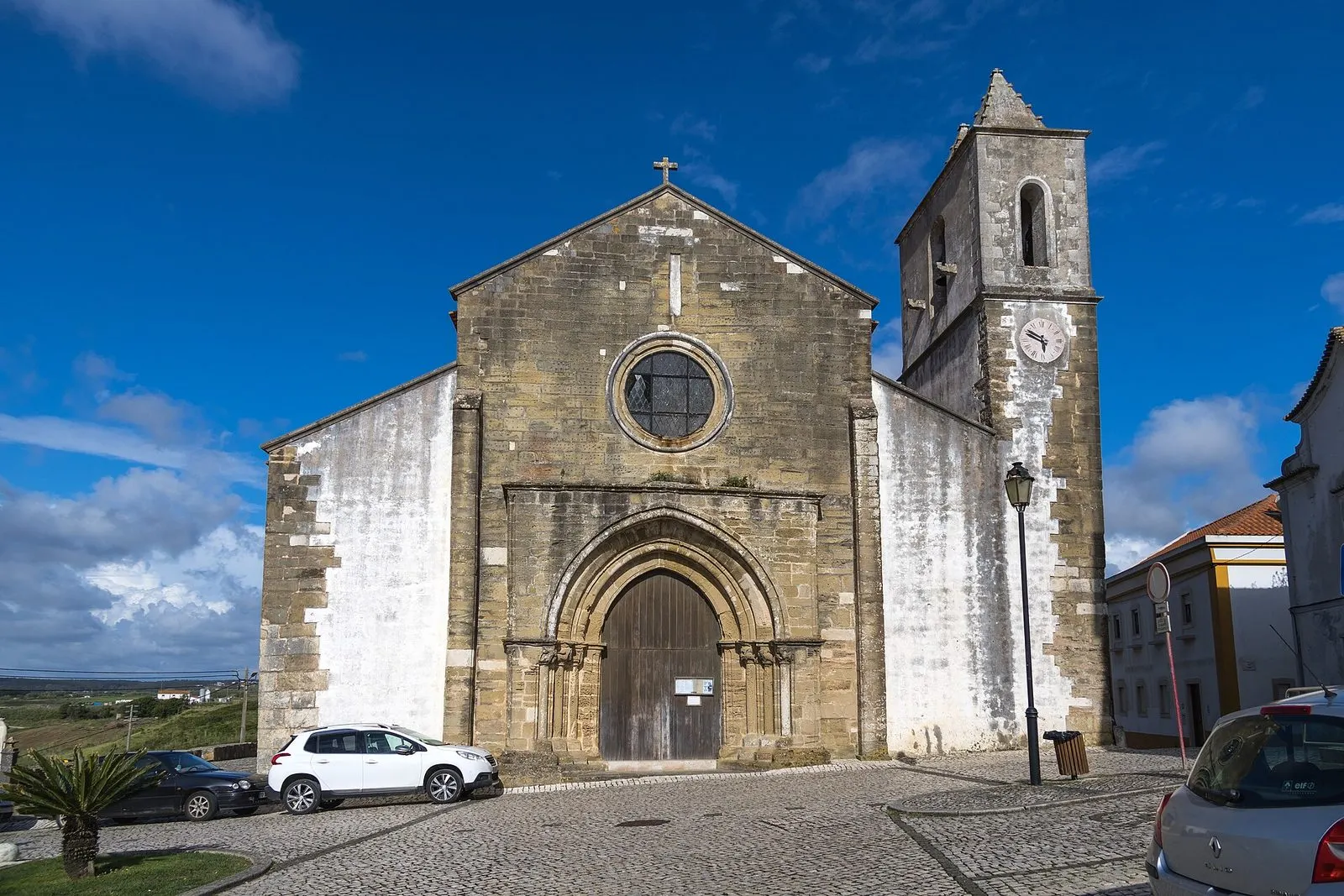
The Parish Church of Atouguia da Baleia, also known as the Church of São Leonardo, stands in the former town of Atouguia da Baleia, in the municipality of Peniche, on the Oeste coast, and its best-known neighbour is the Fortaleza de Peniche. Seen from the front, it is an austere ashlar façade with a broken-arch portal, an oculus in the gable and a bell tower beside it, topped by a pyramid. Behind this sobriety is a church that tourist information describes as the oldest Christian church in the municipality, and which mixes features of the Romanesque and the Gothic, with additions in the Manueline style.
A dating still open
Sources do not agree on the date of construction. The Junta de Freguesia de Atouguia da Baleia says the church was probably built by the late twelfth century; the Infopédia states that the foundation date is unknown and proposes the transition from the thirteenth to the fourteenth century, noting that some authors push it back on account of affinities with the early Gothic of Santarém; an academic article from 2024 points to the early fourteenth century. As we could not read the national register file, we treat the period between the late twelfth and the early fourteenth century as the most cautious range. For the chronological atlas, we use the thirteenth century.
Two references help order the later phases. A summary of the SIPA inventory record, which we accessed only indirectly, indicates that the choir was built in the 1460s, under the patronage of the countess of Atouguia, and that Domingos Bartolomeu, a royal official, died in 1371 and is buried in the nave, according to an inscription. The blog Andarilho adds that the counts of Atouguia, who held the town from the fifteenth century, are buried in the chancel.
Architecture
The main portal, according to the Junta de Freguesia, has three archivolts resting on small carved capitals. The Infopédia describes the noble façade with the portal set within a square body, between long buttresses, and mentions an earlier south portal with a less pointed arch. The bell tower, built against the façade, ends in two pyramids, according to the Junta. The interior is described as sober, of stone and whitewashed walls.
Later additions show that the church continued to be worked on: the sacristy has a Manueline doorway with an ogee arch, according to the Infopédia. A local tradition, which is not documented, says that whale bones from whales caught by fishermen of the old port of Touria or Atogia were used in parts of the building. The blog Andarilho mentions a large whale jawbone leaning against a wall, which it says came from Peniche and not from the church.
What to see inside
The Infopédia and the blog Andarilho refer to five sixteenth-century paintings, including a panel of São Leonardo associated with Diogo de Contreiras, also known as the Master of São Quintino. The sources consulted also mention a limestone relief of a Nativity, which local tradition links to Queen D. Isabel, and a crib attributed to the school of Machado de Castro. These details come from secondary sources and should be confirmed on site. More reliable is the testimony of the Junta de Freguesia on the patron saint: the statue of São Leonardo seen today dates from the sixteenth century, and the church is said to be the only one in Portugal with that invocation. The associated legend tells that a statue of the saint was travelling on a ship carrying Gaulish prisoners, which sank offshore without deaths. It is a foundation tradition, not a historical fact.
Classification and surroundings
The church is a National Monument by Decree No. 37 450 of 16 June 1949 (Diário do Governo, 1st series, No. 129), which, in the district of Leiria, classified the «igreja matriz de Atouguia da Baleia», in the municipality of Peniche, in the same decree that classified other buildings in other districts. The alternative designation in the Atlas is «Igreja de São Leonardo, matriz de Atouguia da Baleia».
In the same town, the pillory, the wayside cross and the remains of the tower and walls of the former castle are classified as Property of Public Interest. A visitor to the church can therefore read, along a short route, traces of a medieval town with a castle and counts.
Planning the visit
The liturgical feast of São Leonardo is on 6 November, usually celebrated on the nearest Sunday, and the São Leonardo Fair fills the whole of 6 November, according to the Junta de Freguesia. When we consulted sources on 5 November 2026, we found no published opening hours, and the Junta listed only a contact form and its Facebook page. Please confirm in advance with the Junta de Freguesia de Atouguia da Baleia or the parish, especially on days of worship. For other monuments in the municipality, see the parish churches and the Fortaleza de Peniche.
Photograph by Alexey Komarov (Alexkom000), dated 12 May 2026. Original on Wikimedia Commons, under CC BY 4.0; resized and compressed for the web, without altering the composition.
Frequently asked questions
- What is the date of the Parish Church of Atouguia da Baleia?
- The dating is debated. The Junta de Freguesia probably points to the late twelfth century, the Infopédia speaks of the transition from the thirteenth to the fourteenth century, and more recent articles place construction in the early fourteenth century. The building itself shows several phases, with the choir from the 1460s and Manueline details.
- What is its classification?
- National Monument, by Decree No. 37 450 of 16 June 1949 (Diário do Governo, 1st series, No. 129), under the designation «Igreja matriz de Atouguia da Baleia».
- Why is it called São Leonardo?
- The Junta de Freguesia records a legend according to which a statue of São Leonardo was travelling on a ship that wrecked off Atouguia without loss of life, and the town is said to have built the church in gratitude. It is a local tradition, not a documented fact. The liturgical feast is on 6 November.
- Can I visit the church?
- When we consulted sources on 5 November 2026, we found no published opening hours. The Junta de Freguesia de Atouguia da Baleia lists only a contact form and a Facebook page, so it is advisable to confirm with the Junta or the parish.
Sources
- Património Cultural, I.P. — Igreja matriz de Atouguia da Baleia (71114)
- Património Cultural, I.P. — Atlas do Património Classificado (NINV 3124)
- Diário do Governo — Decreto n.º 37 450, de 16 de junho de 1949 (1.ª série, n.º 129)
- Junta de Freguesia de Atouguia da Baleia — Igreja de São Leonardo
- Infopédia — Igreja de S. Leonardo de Atouguia da Baleia
- Andarilho — O surpreendente património religioso de Atouguia (e do osso) da Baleia (2020)
- Wikidata — Igreja matriz de Atouguia da Baleia (Q5994266)
Keep exploring
Heritage nearby
More places to discover from here. Approximate straight-line distances, within 50 km.