Monuments
Botanical Garden of the University of Coimbra
The University of Coimbra Botanical Garden, created in 1772 under Pombal's reform: greenhouse finished in 1865, IIP listing and part of the World Heritage site.
- Location
- Coimbra, Coimbra
- Built
- 1772–1774 (criação e início das obras); estufa concluída em 1865
The Botanical Garden of the University of Coimbra occupies a small valley between the university’s Alta and the Mondego, with about 13 hectares of terraces, avenues, greenhouses and woodland. It was founded as a teaching instrument during the Pombaline reform of the University and remains a scientific garden, with living collections organised for study. For visitors, it is also one of the calmest ways to explore the University of Coimbra – Alta and Sofia.
A garden for teaching botany
The University’s reform of 1772, carried out under the Marquis of Pombal, introduced or reorganised the study of natural sciences and created the spaces needed for that teaching. The University of Coimbra identifies the Botanical Garden as one of these works, alongside the Chemistry Laboratory, the Physics Cabinet and the Natural History Gallery.
According to the national register, the Italian naturalists Domingos Vandelli and João Dalla Bella and the engineer Guilherme Elsden took part in creating the garden. Work began in 1774 under Vandelli’s direction, on land acquired from the Marian and Benedictine friars; Júlio Mattiazi drew up the plans and supervised the first plantings. Originally, the programme was modest: a square terrace limited to the «hervas medicinaes» (medicinal herbs) needed for botanical exercises. The teaching of agriculture, provided for in later curricula, justified the subsequent extensions.
Félix de Avelar Brotero, director from 1791 to 1811, systematised the collection, acquired land and carried out building works. The national register cites a map of 1795 by Manuel Macomboa, which records the completion of the linear beds of the botanical school arranged according to the Linnaean system. Decrees of 1836, 1840 and 1848 added to the garden the enclosure of the Monastery of São Bento and part of the enclosure of the Discalced Carmelites, intended for the cultivation of trees and shrubs.
The greenhouse and the nineteenth-century directors
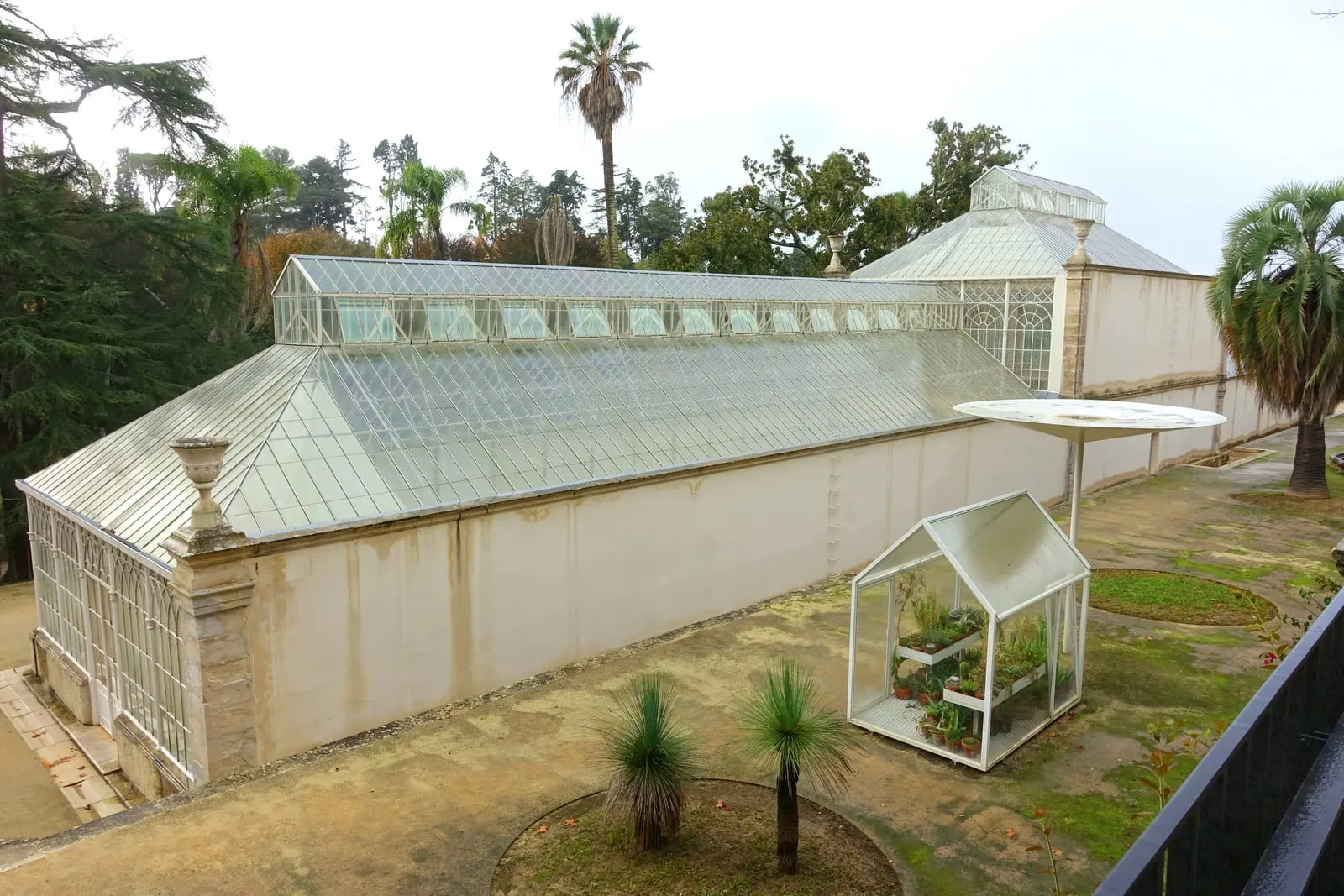
Under Henrique do Couto d’Almeida, from 1854, large water reservoirs for irrigation were built, along with José Pezerat’s «magnificent iron and crystal greenhouse», completed in 1865. From 1866, the greenhouse was directed by Edmond Goëze. The University presents this Tropical Greenhouse, also known as the Great Greenhouse, as one of the oldest buildings of iron architecture in Portugal. The requalification project won the National Urban Rehabilitation Prize in 2017, in the category of best intervention with social impact. Inside, the plants are arranged in sections of tropical, subtropical and temperate climate.
The first Index Seminum, the seed catalogue for exchange with other institutions, dates from 1868, according to the national register. Júlio Henriques, director from 1873 and founder of the Sociedade Broteriana, intensified the exchange of plants and reorganised the collection. Luís Carrisso, director from 1918, created new systematic schools, including that of the Monocotyledons, and enriched the collection with plants from what were then the Portuguese colonies. In 1925, the Dr. Júlio Henriques Botanical Institute, which encompasses the garden, was created.
The present design of the central square dates from the twentieth century. During the directorship of Abílio Fernandes (1942–1974), a proposal from 1945 by Cottinelli Telmo and Armand Bellinghen was implemented: the borders that guided the collection were removed, concentric beds were designed, boxwood topiary was introduced, and the large fountain was installed in the central pond.
What to see
The University describes two distinct parts. The Classical Garden, in the higher area, is organised into terraces and avenues with ashlar walls, wrought-iron gates, pools and a fountain. Here are the Central Square, the Upper Terrace, the Schools of Systematics and the Medical School, the Avenue of Lime Trees and the Tropical Greenhouse. The national register describes five rectangular terraces around the original botanical plot, linked by three double staircases with gates. It also highlights old specimens, such as the Erythrina crista-galli and the Cryptomeria japonica planted in the garden’s early years.
The Mata, an arboretum occupying about two-thirds of the area, descends more naturally through the valley. It includes the bamboo grove, the cold greenhouse, collections of monocotyledons and eucalyptus, an orchard, the chapels of São Bento and Santo Ilídio, and remains of the city’s walled enclosure.
Classification and World Heritage
The national register classifies the Botanical Garden of the University of Coimbra, including its enclosure, as a Property of Public Interest, by Decree No. 2/96 of 6 March (Diário da República, I série-B, No. 56). The decree places it on Avenida de Júlio Henriques and Rua de Vandelli, bordering the São Sebastião Aqueduct.
The garden is also part of the property University of Coimbra – Alta and Sofia, inscribed on the World Heritage List in 2013. It is not a separate inscription. The statement of outstanding universal value, published by Notice No. 14917/2013, names «the Botanical Garden» among the eighteenth-century elements of the Alta, together with the Chemistry Laboratory and the University Press. The Cultural Heritage Atlas confirms that the garden lies within the boundaries of the inscribed property. In the same area is the Joanine Library.
Planning your visit
The national register places the garden between Avenida Júlio Henriques and Rua Domingos Vandelli; the University uses the side entrance near the Garden Arches as the meeting point for visits. When consulted on 5 November 2026, the University’s tourism page listed winter hours of 09:00 to 17:30 (1 October to 31 March) and summer hours of 09:00 to 20:00 (1 April to 30 September). The same page warned that restoration and requalification works temporarily prevented access to some areas. Some spaces are not accessible to people with reduced mobility or to pushchairs. The University offers guided visits to the garden and the Tropical Greenhouse; please confirm conditions, prices and closure dates at visit.uc.pt before you go.
To compare with other scientific and recreational gardens, see historic gardens and the National Museum of Natural History and Science in Lisbon, which incorporates the Lisbon Botanical Garden.
Photograph by Daderot, 4 November 2019. Original on Wikimedia Commons, under CC0 1.0; resized and compressed for the web, without altering the composition.
Frequently asked questions
- When was the Botanical Garden of Coimbra created?
- It was created as part of the University's Pombaline reform of 1772, on the initiative of the Marquis of Pombal. According to the national register, work began in 1774 under the direction of Domingos Vandelli.
- Is the Botanical Garden part of the World Heritage Site?
- Yes. The statement of outstanding universal value for the University of Coimbra – Alta and Sofia, inscribed in 2013, names the Botanical Garden among the eighteenth-century elements of the Alta. It has no separate UNESCO inscription of its own.
- What national classification does it have?
- It is classified as a Property of Public Interest, under the designation «Botanical Garden of the University of Coimbra, including its enclosure» (cerca), by Decree No. 2/96 of 6 March.
- What are the garden's opening hours?
- When consulted on 5 November 2026, the University listed 09:00–17:30 from 1 October to 31 March and 09:00–20:00 from 1 April to 30 September. Some areas were temporarily closed for works. Please check visit.uc.pt.
Sources
- Património Cultural, I.P. — Jardim Botânico da Universidade de Coimbra, incluindo a respectiva cerca (73924)
- Diário da República — Decreto n.º 2/96, de 6 de março
- Diário da República — Aviso n.º 14917/2013 (inscrição da Universidade de Coimbra – Alta e Sofia na Lista do Património Mundial)
- Património Cultural, I.P. — Atlas do Património Classificado e em Vias de Classificação
- Universidade de Coimbra — Visitar a UC: Jardim Botânico e Estufa Tropical
- Universidade de Coimbra — Visitar a UC: Horário de funcionamento
- Wikidata — Jardim Botânico da Universidade de Coimbra (Q66942450)
Keep exploring
Heritage nearby
More places to discover from here. Approximate straight-line distances, within 50 km.