Monuments
Garden of the Episcopal Palace of Castelo Branco
Baroque garden of Bishop D. João de Mendonça at the Episcopal Palace in Castelo Branco: staircases of kings and apostles, statuary and visitor information.
- Location
- Castelo Branco, Castelo Branco
- Built
- c. 1715–1726; obras após 1782
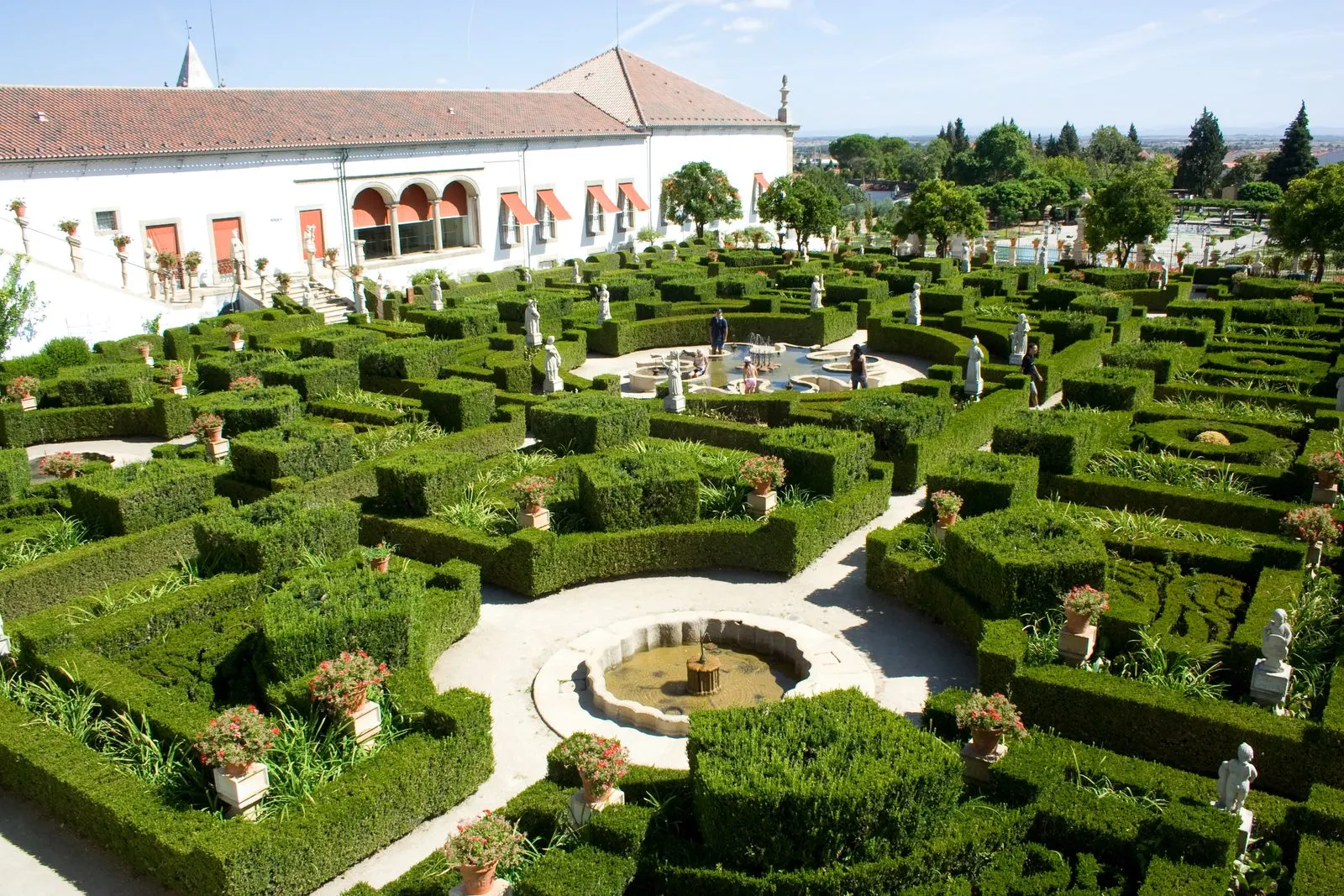
The Garden of the Episcopal Palace of Castelo Branco is a terraced Baroque garden, peopled with granite statues, pools and box hedges, laid out behind the former residence of the bishops. The Municipality also calls it the Garden of São João Baptista, as it is dedicated to that saint. More than a promenade garden, it is a symbolic programme in stone: kings, apostles, virtues, seasons and signs of the zodiac arranged in routes that the visitor can read.
A garden of bishops
The Palace was founded at the end of the 16th century by D. Nuno de Noronha, Bishop of Guarda. According to the national register, the inscription on the entrance portal of the forecourt gives May 1596 as the start of the works, which were completed two years later. Castelo Branco then belonged to the diocese of Guarda, and the Palace served as residence for several of its bishops. The diocese of Castelo Branco was only created in 1771; its bishops used the Palace until 1831, according to the Municipality.
The garden is due to D. João de Mendonça, Bishop of Guarda. Decree no. 15/2018 places its construction in the first quarter of the 18th century, alongside the remodelling of the Palace, and describes it as a garden of «erudite Italian taste», organised in terraces with moralising statuary, topiary, staircases, pools and fountains.
Sources differ on the author of the design. The national register (Património Cultural, 2016) dates the rebuilding of the Palace and the execution of the gardens to 1715–1725 and attributes the design to Valentim da Costa Castelo Branco. The municipal text says the bishop had the garden built around 1720, after three years in Rome, and that the original design and its author are unknown, admitting the hypothesis of an Italian architect. The same text mentions dates inscribed in the garden itself: 1725 on the pedestals of São João Baptista and Mary Magdalene, and 1726 on the Tablets of the Law of Moses. Also in 1726, a footbridge was built over the former Rua da Corredoura, linking the garden to the bishop’s orchards without crossing the public road.
After 1782, Bishop D. Frei Vicente Ferrer da Rocha carried out further works in the Palace, the gardens and the grove, with the collaboration of the Dominican architect Daniel da Sagrada Família, according to the national register. It was during this period that the acquisition of the ornamental pieces that now populate the Palace and gardens intensified.
From episcopal grounds to municipal garden
In the 18th century, the garden was only one part of the Palace’s grounds, which included olive groves, vineyards, a grove and landscaped orchards. After 1834, with the installation of public services in the Palace, these spaces were abandoned. According to the Municipality, in 1911, as a consequence of the Law of Separation, the garden passed to the Câmara by lease. It opened to the public on 5 October 1912 and was purchased in 1919, becoming a municipal garden. The current entrance, from Rua Bartolomeu da Costa, was designed in 1936 by the engineer Manuel Tavares dos Santos.
The Palace today houses the Francisco Tavares Proença Júnior Museum, linked to the safeguarding of the Castelo Branco embroidery. On the relationship between episcopal residences and gardens, see seminaries and episcopal palaces.
How to read the garden
The Municipality divides the garden into four linked areas: the entrance, the box terrace, the flooded garden and the upper level.
At the entrance, panels of blue-and-white azulejo show old views of the town and portraits of the two bishops who most shaped the garden. The Box Garden, rectangular in plan, is divided into 24 plots with box hedges and has five fountain pools, which the municipal text associates with the five wounds of Christ. The statues form complete or nearly complete cycles: the zodiac, the four parts of the world, the four seasons, the theological and cardinal virtues, and the Four Last Things of Man (death, judgement, hell and paradise). Of the four elements, only two are present. São João Baptista watches over the whole of the upper level.
Between the box terrace and the flooded garden, with trapezoidal beds that seem to rise from the water, lies the Lake of the Crowns. Here stand the kings of the fourth dynasty up to D. José I. To the east, a monumental staircase presents the kings of the 1st and 2nd dynasties and Count D. Henrique. On the lower landing, on a smaller scale, stand the Philips and Cardinal D. Henrique. The Municipality also notes Italian-style water games, which soak unwary visitors. To the west, another staircase presents the apostles, identifiable by the symbols of their martyrdom, with the four evangelists and their symbols on the landing.
On the upper level, Moses crowns the cascade that feeds the large irrigation tank. Next to the Palace, a 33-step staircase displays on its balusters busts of the four Doctors of the Western Church.
Classification
The garden has no independent classification. It forms part of the National Monument designated Paço Episcopal de Castelo Branco, incluindo o Jardim Episcopal e o passadiço (Episcopal Palace of Castelo Branco, including the Episcopal Garden and the footbridge). The Palace was classified by the Decree of 16 June 1910 (Diário do Governo no. 136, of 23 June 1910). Decree no. 15/2018, of 18 May (Diário da República, 1st series, no. 96), extended the classified area to the garden and the footbridge and gave the monument its current designation. The decree justifies the extension by the historical, symbolic and urban relationships between the Palace and the garden, and by the garden’s value as an example of Baroque art in the interior of the country. An earlier procedure, which also included the kitchen garden and the Bosque dos Loureiros (now Parque da Cidade), was archived in 2013.
Preparing the visit
Entry is through the Garden of the Palace Interpretation Centre, on Rua Bartolomeu da Costa, where tickets are purchased. At the consultation of 5 November 2026, the municipal pages listed opening hours of 9:00 to 19:00 from April to September. For October to March, one page gave 9:00–18:00 and another 9:00–17:00; please confirm before going. The published prices were €3 (general) and €2 (over 65s and groups of more than 12 people), with free admission for children up to 10 years old, researchers, journalists, tourism professionals and school visits. The Interpretation Centre’s page indicated free admission in the mornings, until 13:00, on the first Sunday of each month. Please confirm on the municipal page for the garden or by calling the Câmara’s general line, 272 330 330.
To compare with other Baroque and pleasure gardens, continue to historic gardens and Baroque architecture in Portugal.
Photograph by Bennekikkek, 18 August 2008. Original on Wikimedia Commons, under CC BY 3.0; resized and compressed for the web, without altering the composition.
Frequently asked questions
- Who commissioned the Episcopal Palace Garden?
- Bishop D. João de Mendonça of Guarda, in the first quarter of the 18th century. The Palace of Castelo Branco was then the residence of the bishops of Guarda; the diocese of Castelo Branco was only created in 1771.
- Is the garden classified?
- Yes, as part of the National Monument «Paço Episcopal de Castelo Branco, incluindo o Jardim Episcopal e o passadiço» (Episcopal Palace of Castelo Branco, including the Episcopal Garden and the footbridge). The palace was classified by the Decree of 16 June 1910; Decree no. 15/2018, of 18 May, extended the classification to the garden and the footbridge.
- Which statues can be seen on the staircases?
- According to the Municipality, one staircase holds the kings of the 1st and 2nd dynasties and Count D. Henrique, with the Philip kings and Cardinal D. Henrique, on a smaller scale, on the lower landing; the other holds the apostles, with the four evangelists at the back. The kings of the 4th dynasty up to D. José I line the Lake of the Crowns.
- How much is the entrance fee?
- At the consultation of 5 November 2026, the Municipality listed €3 (general) and €2 for visitors over 65 and groups of more than 12 people, with free admission for children up to 10 years old and other categories. Please check the municipal website before visiting.
Sources
- Património Cultural, I.P. — Paço Episcopal de Castelo Branco, incluindo o Jardim Episcopal e o passadiço (70390)
- Diário da República — Decreto n.º 15/2018, de 18 de maio
- Património Cultural, I.P. — Atlas do Património Classificado e em Vias de Classificação
- Município de Castelo Branco — Passeio é no Jardim do Paço
- Município de Castelo Branco — Centro de Interpretação do Jardim do Paço
- Wikidata — Jardim do Paço Episcopal de Castelo Branco (Q1862815)
Keep exploring
Heritage nearby
More places to discover from here. Approximate straight-line distances, within 50 km.