Monuments
Seiça Monastery
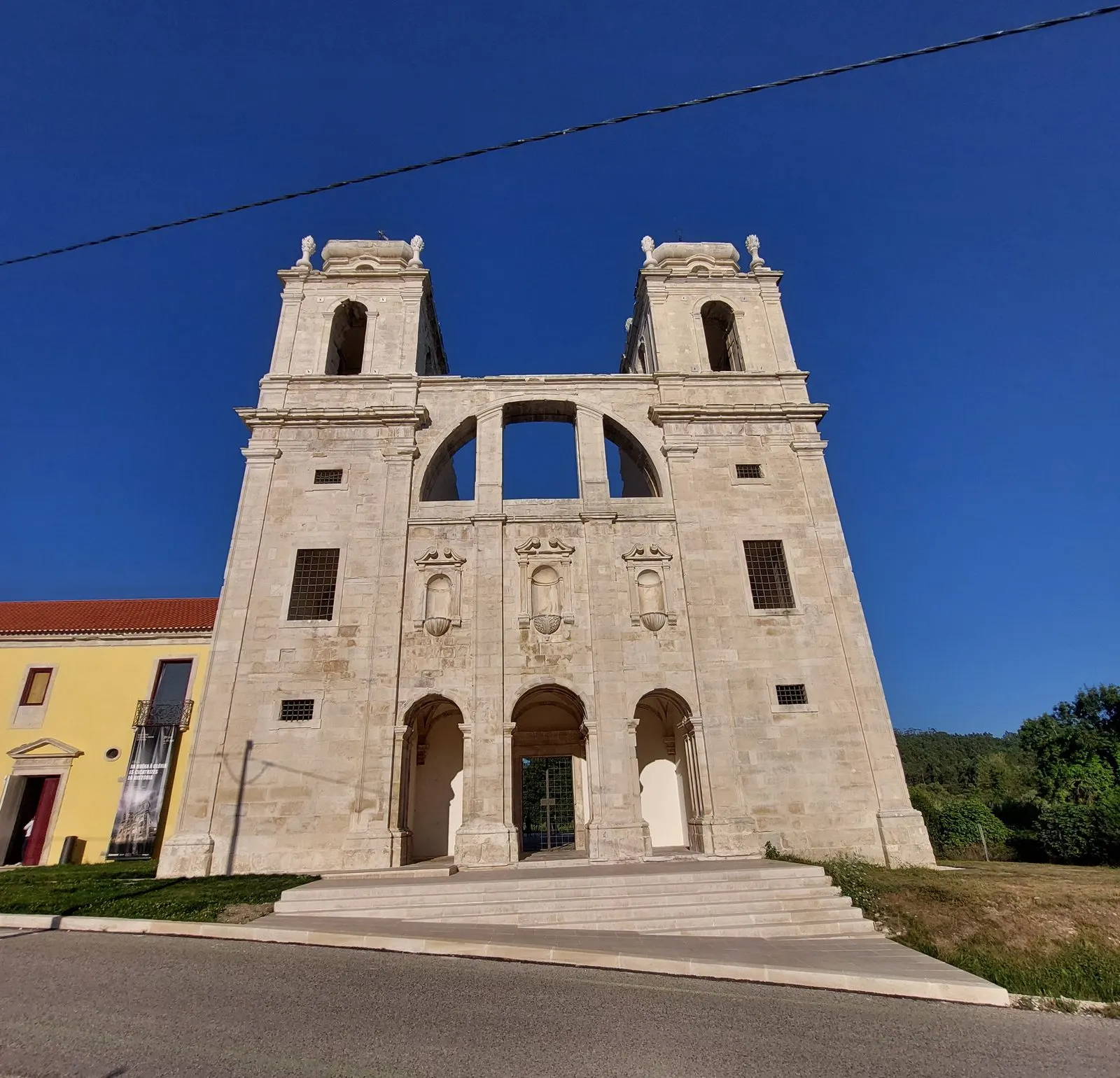
Seiça Monastery, Figueira da Foz: Cistercian house, Mannerist church with two towers, former rice factory, rehabilitated in 2024. A National Monument.
- Location
- Seiça, Paião, Figueira da Foz, Coimbra
- Built
- Séculos XII (fundação) e XVI–XVII (reedificação maneirista); reabilitado em 2022–2024
The Monastery of Santa Maria de Seiça stands in a valley of the parish of Paião, in the south of the municipality of Figueira da Foz, beside the Seiça stream and the Oeste railway line. It was a Cistercian house within the orbit of Alcobaça, rebuilt in Mannerist style and later degraded by successive uses, including a rice mill. Since 2024 it has been a municipal cultural space, open to the public after a rehabilitation of the conventual building and the church façade.
From Augustinian Canons to White Monks
The exact date of foundation is unknown. The national heritage register indicates that the earliest documentary reference to the monastery, beside the River Mondego, is from 1162, when it belonged to the Augustinian canons, and that in 1175 King Afonso Henriques granted it a charter of couto (immunity). During the reign of King Sancho I, the same register says, there were only two Cistercian daughter houses of Alcobaça, Maceira Dão in 1188 (see the Monastery of Maceira Dão) and Seiça in 1195, from which point the house housed White Monks. The 2023 decree summarises this history, adding the monks’ role in the reorganisation of the territory of the Mondego estuary.
Under the protection of the Crown, the monastery was suppressed by King John III, due to disputes with Alcobaça, and restored to its mother house by King Sebastian in 1560. Between the late sixteenth and early seventeenth centuries the conventual building was entirely rebuilt, to a design by Mateus Rodrigues, and it came to function as a centre of philosophical studies for the order, owing to its proximity to the College of Santa Cruz in Coimbra.
The Mannerist Church
The church is the most notable element. The register describes an austere, vertical and robust layout, «very much in the taste of plain Mannerism», with a façade marked by two lateral towers and a central body unified by colossal-order pilasters. Those wishing to situate this vocabulary may consult the pages on Mannerism in Portugal and plain architecture. Before the rehabilitation, the register noted that the interior had been greatly altered by the installation of a rice-husking factory in the nineteenth century, and that the transept, which would have been covered by a dome, and the chancel collapsed after the building was sold, in 1834. Of the conventual complex, two wings of the cloister, some cells, the refectory and the library survived.
Extinction, Factory and Purchase by the Municipality
According to the municipal website, after 1834 the State held the complex, and a law of 22 February 1861 handed the church and sacristy to the parish council of Nossa Senhora do Ó do Paião. The furnishings were reused in other churches and chapels of the municipality. The parish council sold the monastery to private owners in 1895, there was a further sale in 1911, and the large chimney beside the building recalls the rice factory, which according to RTP operated from the early twentieth century until 1976. The Municipality of Figueira da Foz acquired the property in 2004.
Rehabilitation and Classification
The monastery was classified as a property of public interest by Decree No. 5/2002, although the designated area covered only the church. The Câmara requested reclassification in 2017, and Decree No. 13/2023 of 7 July (Diário da República, 1st series, No. 131) reclassified it as a National Monument and extended the classified area to the whole conventual zone. The decree underlines the church, «of unusual dimensions and Mannerist design», despite the alteration of its interior. It is not part of any UNESCO inscription.
The rehabilitation and consolidation works, under the Centro 2020 programme, ran from January 2022 to January 2024, with architectural design by Atelier 15 and construction by the Grupo Teixeira Duarte, according to the municipal page. RTP/Lusa reports a contract award of about 2.7 million euros, in December 2021, co-financed at 85%, to consolidate the monumental church façade and rehabilitate the adjoining conventual building, with a delay caused by archaeological work. The President of the Republic inaugurated it on 26 January 2024.
Preparing a Visit
When consulted on 5 November 2026, the municipal website listed visits from Wednesday to Sunday, from 10:30 to 12:30 and 14:00 to 18:00, with visitor entry until 30 minutes before closing. The general ticket cost 3.00 €, with 1.50 € for those over 65, a 50% discount for families, 20.00 € for organised groups of 15 to 20 people, and free entry, among others, for children up to 12. Guided visits require advance booking, and there is a digital guide in nine languages. Hours have changed since opening (in September 2024 the local press reported afternoons only, with closure on 1 January, Good Friday, Easter Sunday, 24 June and 25 December), so confirm on the municipal page before going.
The space also functions as a venue for exhibitions, concerts and conferences. According to the municipality, between June 2024 and January 2026 more than 14,600 visits were recorded, not counting free performances or major events, and the exhibition «Dispersos: Fragmentos de Memória», with about 40 stone sculpture pieces from the reserves of the Machado de Castro National Museum, had its closing visit on 25 January 2026. For comparison with other houses of the order, see the Cistercian routes in Portugal and the monasteries.
Photograph by Threeohsix, 4 August 2024. Original on Wikimedia Commons, under CC BY-SA 4.0; resized and compressed for the web, without altering the composition.
Frequently asked questions
- How was Seiça Monastery connected to the Cistercians?
- According to the national heritage register, the earliest known reference, from 1162, shows it as a house of Augustinian canons. In 1195 it became one of two Cistercian daughter houses of Alcobaça during the reign of King Sancho I (the other was Maceira Dão, in 1188), and it began to house White Monks.
- What is its classification?
- National Monument, under Decree No. 13/2023 of 7 July (Diário da República, 1st series, No. 131), which extended the classified area to the whole conventual zone. It had been classified as a property of public interest since Decree No. 5/2002, but only the church was covered. It is not part of any UNESCO inscription.
- Is it a ruin?
- It is no longer just a ruin. The municipality rehabilitated the conventual building and consolidated the church façade in works from January 2022 to January 2024, inaugurated on 26 January 2024. The church interior was badly deteriorated, and the chancel and transept collapsed after 1834, according to the national register.
- Can it be visited?
- When consulted on 5 November 2026, the municipal website listed visiting hours from Wednesday to Sunday, 10:30 to 12:30 and 14:00 to 18:00, with a general ticket costing 3.00 euros. Guided visits require advance booking. Always confirm before going.
Sources
- Património Cultural, I.P. — Mosteiro de Santa Maria de Seiça (71634)
- Património Cultural, I.P. — Atlas do Património Classificado e em Vias de Classificação (NINV 402)
- Diário da República — Decreto n.º 13/2023, de 7 de julho (1.ª série, n.º 131)
- Município da Figueira da Foz — Mosteiro de Santa Maria de Seiça (visita, horário e preços)
- Município da Figueira da Foz — Mosteiro de Seiça assinala dois anos de abertura ao público (26 de janeiro de 2026)
- RTP Notícias — Mosteiro de Seiça na Figueira da Foz reclassificado como monumento nacional
- Observador — Presidente da República vai inaugurar o Mosteiro de Seiça na Figueira da Foz (12 de janeiro de 2024)
- Figueira na Hora — Mosteiro de Santa Maria de Seiça com novo horário e preçário (17 de setembro de 2024)
- Figueira na Hora — Mais de 14.600 visitas ao Mosteiro de Seiça em dois anos de atividade (26 de janeiro de 2026)
- Wikidata — Mosteiro de Santa Maria de Seiça (Q66942767)
Keep exploring
Heritage nearby
More places to discover from here. Approximate straight-line distances, within 50 km.