Resources
Museu de Arqueologia D. Diogo de Sousa
Discover the D. Diogo de Sousa Archaeology Museum in Braga before you go: 1918 origins, Bracara Augusta collections, Roman mosaic in situ, 2007 building.
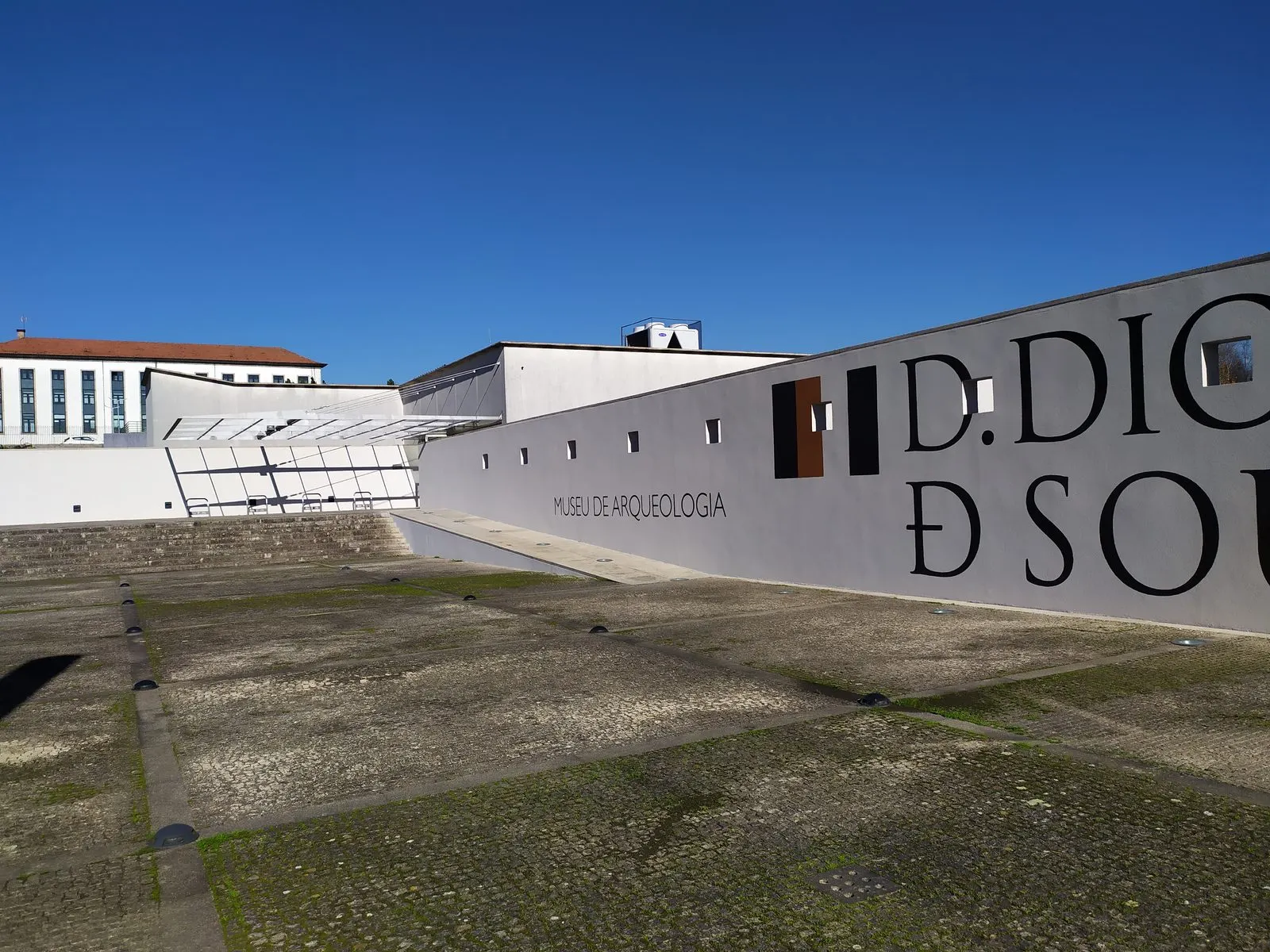
- Location
- Braga, Braga
- Built
- 2007 (edifício atual, construído de raiz)
The Museu de Arqueologia D. Diogo de Sousa is the archaeology museum of Braga and the starting point for understanding Bracara Augusta, the Roman city from which Braga originates. The current building, opened in 2007, was built from the ground up on the most significant archaeological area of the Roman city. The museum depends on Museus e Monumentos de Portugal, E.P.E. and is part of the Rede Portuguesa de Museus.
A museum founded in 1918
The name honours the archbishop D. Diogo de Sousa (1461–1532). The museum attributes to him important urban renovations of Braga and the first attempts to protect the city’s Roman remains. His tomb is in the Sé de Braga.
Between the 16th and 19th centuries there were several initiatives to create a museum, but it was only in 1918 that the Museu D. Diogo de Sousa emerged, as a museum of archaeology and general art. The official website gives as its founding instrument Decree no. 4 011, of 28 March 1918. The museum was installed in the Archbishop’s Palace, with a curator-director and a guard.
Operation was irregular for decades. In 1980, Decree-Law no. 409/80, of 27 September, revitalised it as the Regional Museum of Archaeology, with its own competences in this field. Since then, it has worked on the preservation, enhancement and dissemination of the local and regional archaeological heritage, and opened to the public in the new building on 29 June 2007.
The building
The design is by the architects Carlos Guimarães and Luís Soares Carneiro. The building articulates three bodies: the technical services, the café and the public area. The technical services include a conservation and restoration laboratory that also works on collections from other museums in the region. The public area brings together the exhibition rooms, an auditorium, a shop, a library and the educational service. The landscaped outdoor spaces are freely accessible.
Because it was built over the Roman city, the museum is also an archaeological site. Excavations carried out before construction uncovered a 1st-century house with a mosaic floor. The high acidity of Braga’s soil rarely allows such finds to survive, so the mosaic was integrated into the crypt of the service block. It has two geometric panels in black and white: one a chequerboard of crosses and the other a grid of hourglasses.
The permanent exhibition
The exhibition covers human occupation of northern Portugal from the Palaeolithic to the Middle Ages. It opens with the history of the museum and of the region’s archaeology, and is then organised into four rooms:
- Room 1: Prehistory and Protohistory, from the Palaeolithic to the Iron Age, with material mainly from sites in the Northwest of the Iberian Peninsula;
- Room 2: the integration of Bracara Augusta into the Roman Empire, trade and technical innovations in the local economy;
- Room 3: the organisation of the city’s public and domestic space;
- Room 4: the Roman roads, the necropolises, Roman and early Christian religiosity, and the medieval core.
The museum stresses that Bracara Augusta was the only provincial capital of the Roman Empire in what is today Portuguese territory and, later, the capital of the Suevic kingdom. The collections have two cores: older finds, mainly inscribed stones without a precise archaeological context, and materials acquired after 1980 from research projects, with their context documented.
In the garden, the Jardim dos Miliários (Milestone Garden) displays outdoors Roman granite milestones and architectural elements such as bases and columns, from various points in the Roman city.
The Bühler-Brockhaus Collection, donated by Hans-Peter Bühler and Marion Bühler-Brockhaus, brings together some 300 pieces, mostly from the Mediterranean world. The donation began with the arrival of the first pieces in 2017. The deed of gift was signed in 2018, and the donation was completed on 2 May 2019 with the handover of a Roman marble portrait of the emperor Augustus.
To place the visit in context, see also Roman archaeology and Roman Portugal.
Protection of the site
When consulted on 5 November 2026, the Atlas do Património Cultural, I.P. did not record the museum building as a classified property. The museum’s coordinates fall within the special protection zone of the Roman Baths of Maximinos (a National Monument under Decree no. 1/86), established by Portaria no. 865/91. This protection results from the baths’ proximity, not from any classification of the museum.
Planning the visit
The museum is at Rua dos Bombeiros Voluntários, 4700-025 Braga. When consulted on 5 November 2026, the official opening hours and tickets page indicated:
- opening hours Tuesday to Sunday, 10:00–17:30;
- closed on Mondays and on 1 January, Easter Sunday, 1 May, 24 June and 25 December;
- tickets at €5, with a 50% discount (€2.50) for visitors over 65 and families with at least one adult and one minor;
- free admission, upon proof, for residents of Portugal on 52 days a year of the visitor’s choice, children under 12 accompanied by an adult, and other categories provided for (see free entry to museums and monuments).
The museum also indicated that the café was temporarily closed and that bus lines 7, 14 and 32 of the TUB stop near the museum. Group visits, educational sessions and filming may have their own conditions: check with the museum in advance.
Photograph by Joseolgon, 22 November 2020. Original on Wikimedia Commons, under CC0 1.0; resized and compressed for the web, without altering the composition.
Frequently asked questions
- When was the Museu D. Diogo de Sousa founded?
- In 1918, as a museum of archaeology and general art, according to the museum's official website, which cites Decree no. 4 011 of 28 March. It was revitalised in 1980 as the Regional Museum of Archaeology and opened in its current building on 29 June 2007.
- Why is it named after D. Diogo de Sousa?
- It honours the Archbishop of Braga, D. Diogo de Sousa (1461–1532), to whom the museum attributes important urban renovations of the city and the first attempts to safeguard the remains of Bracara Augusta.
- What can be seen in the museum?
- Collections from the Palaeolithic to the Middle Ages of the Northwest of the Iberian Peninsula, with emphasis on Bracara Augusta, a 1st-century Roman mosaic preserved on site, milestones in the garden and the Mediterranean collection from the Bühler-Brockhaus donation.
- Is the museum building listed?
- When consulted on 5 November 2026, the Atlas do Património Cultural did not record the building as a classified property. The site lies within the special protection zone of the Roman Baths of Maximinos, a National Monument.
Sources
- Museu de Arqueologia D. Diogo de Sousa — História
- Museu de Arqueologia D. Diogo de Sousa — Edifício
- Museu de Arqueologia D. Diogo de Sousa — Exposição
- Museu de Arqueologia D. Diogo de Sousa — Coleções
- Museu de Arqueologia D. Diogo de Sousa — Mosaico in situ
- Museu de Arqueologia D. Diogo de Sousa — Jardim dos Miliários
- Museu de Arqueologia D. Diogo de Sousa — Sala Bühler-Brockhaus
- Museu de Arqueologia D. Diogo de Sousa — Horário e bilhetes
- Museu de Arqueologia D. Diogo de Sousa — Localização e acessos
- Património Cultural, I.P. — Atlas do Património Classificado e em Vias de Classificação (ZEP das Termas romanas de Maximinos, NINV 2233)
- Wikidata — Museu Regional de Arqueologia Dom Diogo de Sousa (Q5203563)
Keep exploring
Heritage nearby
More places to discover from here. Approximate straight-line distances, within 50 km.

Resources for research
Find the sources. Follow the story.
Guides to researching buildings, exploring museum collections and understanding heritage protection.
SIPA
Get to know the architectural inventory, building records and documentary archive.
Read the guideMuseum collectionsMatrizNet
Explore the museum catalogue and records of works, materials, authorship and provenance.
Read the guideHeritage protectionHeritage classification
Understand cultural property categories and the levels of national, public and municipal interest.
Read the guide