Monuments
Medieval Bridges of the Cávado and the Ave
Ten National Monument bridges across the Cávado, the Ave and their tributaries, from Prozelo and Barcelos to Serves, Mem Gutierres, Lagoncinha and Vizela.
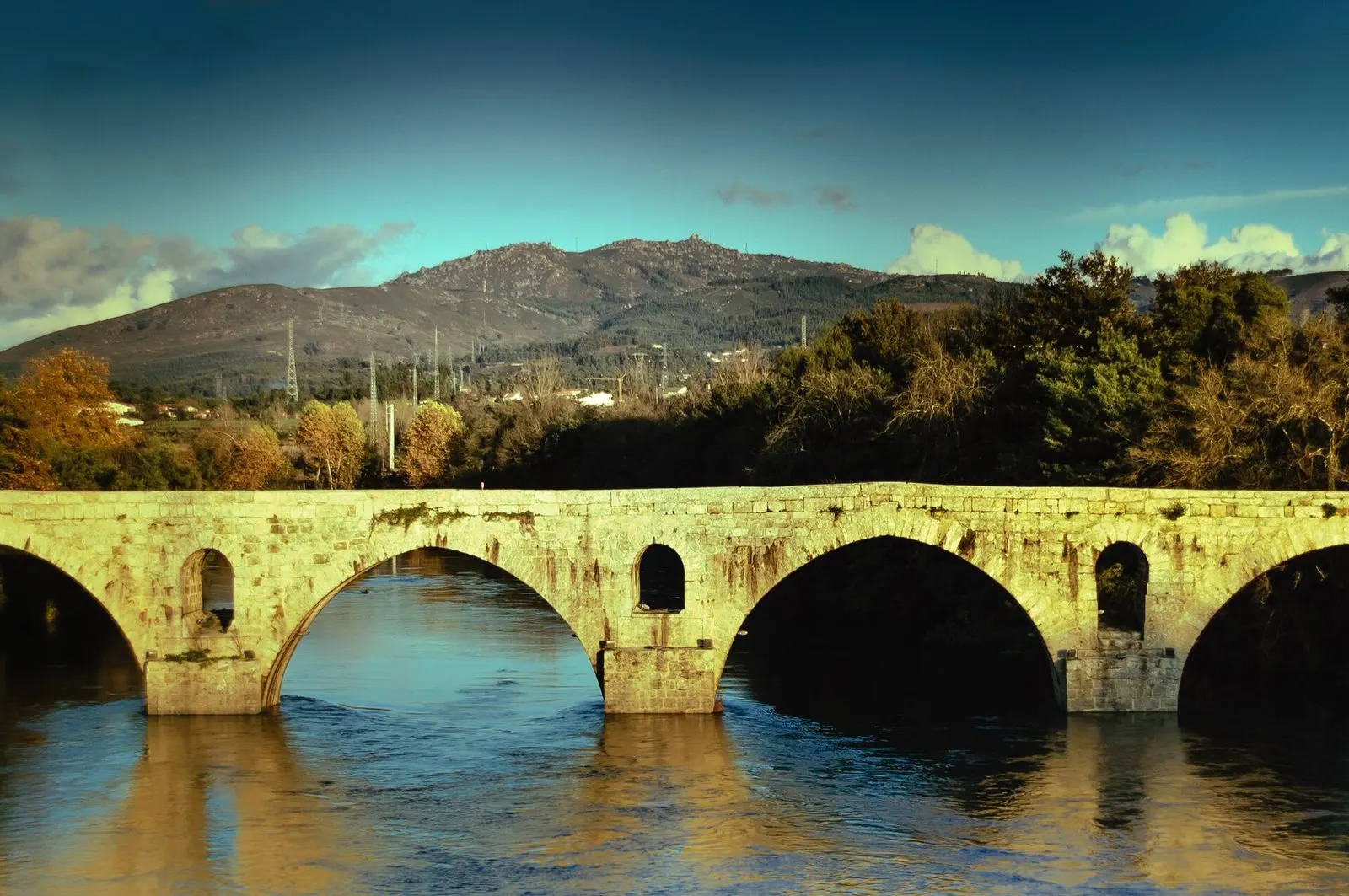
Between the Minho and the Douro, the rivers Cávado and Ave, with their tributaries, were crossed early on by routes linking Braga to the coast, Porto and Galicia. The stone bridges that still span them are among the country’s earliest classified works: seven appear in the decree of 16 June 1910, and three more were added later. This guide brings together ten, all National Monuments, as described in the records of Património Cultural. For the general context of the type, see medieval bridges; for a neighbouring case, see the Ponte de Vilar de Mouros.
A note on the title: not all of them lie on the Cávado or the Ave. The Ponte de Rodas crosses the river Homem, and the Cavez bridge the river Cavez, a tributary of the Tâmega. They are included here because they belong to the same territory of Entre-Douro-e-Minho and to the same family of works.
On the Cávado and the Homem
The Ponte de Prozelo (also Perozello, or Ponte do Porto) links Amares with the municipality of Braga, on the EN 205. It is the largest of the group: about 150 metres long, with a slightly rising deck and fourteen arches, four of them pointed and interspersed with oculi over the cutwaters. The remaining arches are irregular, suggesting partial repairs over time. The record cites Carlos Alberto Ferreira de Almeida (1968), who dated the work to the mid-fourteenth century on the basis of the masons’ marks, but warns that the structure has never been rigorously studied. The designation in the Atlas still reads «between Amares and Póvoa de Lanhoso», but the current record gives the parishes of Amares and Braga.
The Ponte do Prado stands on the EN 201, between Braga and Vila Verde, on the old road from Braga to Ponte de Lima. The record mentions a milestone of Augustus found there and admits a Roman origin. The medieval bridge collapsed in a flood in 1510; the reconstruction fell almost immediately, and in 1616, under the Philippine dynasty, it was rebuilt from the ground up to a design by António de Castro, of Viana. It has nine unequal arches, some full-centred and others pointed. What can be seen is therefore seventeenth-century work, and the record states that nothing of the medieval construction survives.
The Ponte de Barcelos, officially Ponte sobre o Cávado, is Gothic, from the time of D. Pedro, Count of Barcelos (1314–1354). It was under construction in 1325 and ready in 1328, the year the chapel of Santa Maria da Ponte was founded. It has six arches, the two central ones slightly taller, in an almost horizontal profile, with triangular cutwaters upstream and rectangular ones downstream. It lost its north tower, which collapsed in 1800, and its battlements, dismantled in 1881; in 1628 the deck had been levelled and widened. It has had a special protection zone since 1954 (ministerial order of 1953).
The Ponte de Rodas, in Caldelas (Amares), was built over the river Homem in the medieval period, according to the record. It is about 40 metres long and has three full arches, the central one larger, with triangular cutwaters upstream and rectangular ones downstream. It completed the road from Braga to Ponte da Barca. The entry laments that vegetation on the facings is degrading it, and notes some alminhas (roadside shrines) near the entrance on the right bank.
On the Ave and the Vizela
The Ponte de Serves, in Gondar (Guimarães), was probably built in the last quarter of the twelfth century: the will of D. Fernando Martins, of 1185, refers to the works. It has four round arches and, in the eighteenth century, was the obligatory crossing between Guimarães and Famalicão. The medieval structure was heavily altered in the twentieth century, with cement rendering, new voussoirs and iron railings. It was classified in 1938.
The Ponte do Rio Ave, or Ponte das Taipas, in Caldelas (Guimarães), is a case apart: 60 metres long, with 35 rectangular spans resting on 34 low piers and a 3.5-metre deck, very different from the arched bridges. The record notes the Roman hypothesis, linked to the baths of Trajan and the Braga–Guimarães road, but considers the present structure probably modern. It was classified in 1926.
The Ponte de Mem Gutierres, or da Esperança, in Póvoa de Lanhoso, is simple and sturdy: a single, very high pointed arch, with a buttressed extrados and granite parapets, probably from the fourteenth–fifteenth centuries.
The Ponte de Lagoncinha, in Lousado (Vila Nova de Famalicão), has three full arches and three ogival ones, with square cutwaters downstream and triangular ones upstream. It is «very possibly» medieval and is thought to have replaced a Roman bridge on the link between Porto and Braga. In the eighteenth century the Trofa ferry made it secondary. It has a chapel of São Lourenço at one end and alminhas at the other. It was classified in 1943.
The Ponte Velha de Vizela, in Caldas de Vizela, is medieval, predating the fifteenth century, although tradition calls it Roman. It has three full arches of differing spans, with an open arch in the central pier, and its slab deck divides into three planes, with two ramps.
On the Tâmega
The Ponte de Cavez, in Cabeceiras de Basto, dates from the thirteenth century and is about 95 metres long, with a horizontal deck 17 metres above the water, over five unequal arches (three pointed, two round) and three triangular cutwaters. The record cites the stories of its construction, with Frei Lourenço Mendes as promoter, in place of a fragile wooden bridge; it treats them as tradition. The iron railings are a much later intervention.
Reading the group
The group shows that the «medieval» bridge is often a work of layers. Prozelo and Barcelos preserve the essentials of the medieval design; the Prado is almost entirely from 1616; Serves was heavily rebuilt. The profiles also vary: pointed arches and oculi at Prozelo, an almost flat deck at Barcelos, a single arch at Mem Gutierres. For comparison with other regions, see Ponte de Lima and the cities of Braga, Barcelos and Guimarães.
Visiting
These are public, open-air structures with no opening hours. Some serve national or municipal roads, and their condition and traffic restrictions change. The records we consulted on 5 November 2026 give no current information on traffic; check with the municipality of each bridge before crossing.
Photograph by Feliciano Guimarães (Ponte de Prozelo, 17 November 2009). Original on Wikimedia Commons, under CC BY 2.0; resized and compressed for the web, without altering the composition.

Frequently asked questions
- Are all of these bridges medieval?
- No. The official records attribute a medieval origin to several (Prozelo, Barcelos, Serves, Cavez, Mem Gutierres, Vizela), but the Prado bridge was entirely rebuilt in 1616, the Taipas bridge is probably modern, and Lagoncinha is only «very possibly» medieval.
- Are they all classified as National Monuments?
- Yes. Seven were classified by the decree of 16 June 1910; the Ponte do Rio Ave (Taipas) by Decree No. 11 454 of 1926; Serves by Decree No. 28 536 of 1938; and Lagoncinha by Decree No. 32 973 of 1943.
- Which is the largest in the group?
- According to official records, Prozelo, at about 150 metres long with fourteen arches, spanning the Cávado between Amares and the municipality of Braga.
- Can I cross them?
- Several form part of public roads or paths, but their condition and traffic rules change. Check with the relevant municipality before you go.
Sources
- Património Cultural, I.P. — Ponte de Rodas (registo 70653, NINV 2168)
- Património Cultural, I.P. — Ponte de Prozelo (registo 69829, NINV 2167)
- Património Cultural, I.P. — Ponte sobre o Cávado, Barcelos (registo 70518, NINV 2184)
- Património Cultural, I.P. — Ponte do Prado (registo 70616, NINV 2342)
- Património Cultural, I.P. — Ponte de Cavez (registo 71103, NINV 2236)
- Património Cultural, I.P. — Ponte de Serves (registo 70514, NINV 2301)
- Património Cultural, I.P. — Ponte do Rio Ave / Taipas (registo 70560, NINV 2302)
- Património Cultural, I.P. — Ponte de Mem Gutierres (registo 70413, NINV 2314)
- Património Cultural, I.P. — Ponte de Lagoncinha (registo 69842, NINV 2333)
- Património Cultural, I.P. — Ponte Velha de Vizela (registo 70480, NINV 2300)
- Património Cultural, I.P. — Atlas do Património Classificado
- Diário do Governo n.º 136, de 23 de junho de 1910