Monuments
Charterhouse of Évora (Scala Coeli)
Plan a visit to Cartuxa de Évora (Scala Coeli), Portugal's first Carthusian house, founded 1587. Fundação Eugénio de Almeida; church a National Monument.
- Location
- Bacelo e Senhora da Saúde, Évora, Évora
- Built
- Fundado em 1587; comunidade instalada em 1598
The Charterhouse of Évora, or Mosteiro de Santa Maria Scala Coeli (the “ladder of heaven”), lies on the outskirts of Évora, in the parish of Bacelo e Senhora da Saúde. It was the first house of the Carthusian Order in Portugal and housed Carthusian monks from 1587 to 1834 and from 1960 to 2019. It belongs to the Fundação Eugénio de Almeida, the same body behind the winery that uses the name Cartuxa, and the church is a National Monument.
Foundation
According to the Fundação Eugénio de Almeida, in 1583 D. Teotónio de Bragança, Archbishop of Évora, wrote to Pope Gregory XIII offering to finance the first Carthusian house in Portugal, and the request was approved. The General Chapter of the Order sent seven monks, who arrived in Évora on 8 September 1587. The design, chosen by the archbishop, is by the architect and military engineer Giovanni Vincenzo Casale, and the community moved into the new house on 15 December 1598, with the main works completed.
From abandonment to refoundation
The liberal revolution suppressed the male religious orders in 1834. The community was expelled, the property passed to the National Treasury (Fazenda Nacional), and the building had short-lived uses until it fell into ruin. It was bought in 1871 by José Maria Eugénio de Almeida; his son, Carlos Maria Eugénio de Almeida, made it the seat of the Casa Agrícola Eugénio de Almeida. A press article recalls that the building also served as a hospice for poor young women and as a regional agricultural school.
Vasco Maria Eugénio de Almeida, who inherited the monastery and founded the Foundation in 1963, decided to restore its original function. The works took place from 1948 to 1960, and contemplative life returned on 14 September 1960, with seven monks, as many as the founders of 1587. The community, by then reduced to four monks and one lay brother, left Évora on 31 October 2019. In August 2020 the first guided visits to the interior were held, organised by the Foundation.
According to the Foundation, on 4 September 2022 nuns of the Institute of the Servants of the Lord and of the Virgin of Matará, the female branch of the Religious Family of the Incarnate Word, resumed claustral life. The monastery is thus once again a contemplative house, which explains the more restrictive access rules.
What can be seen and what cannot
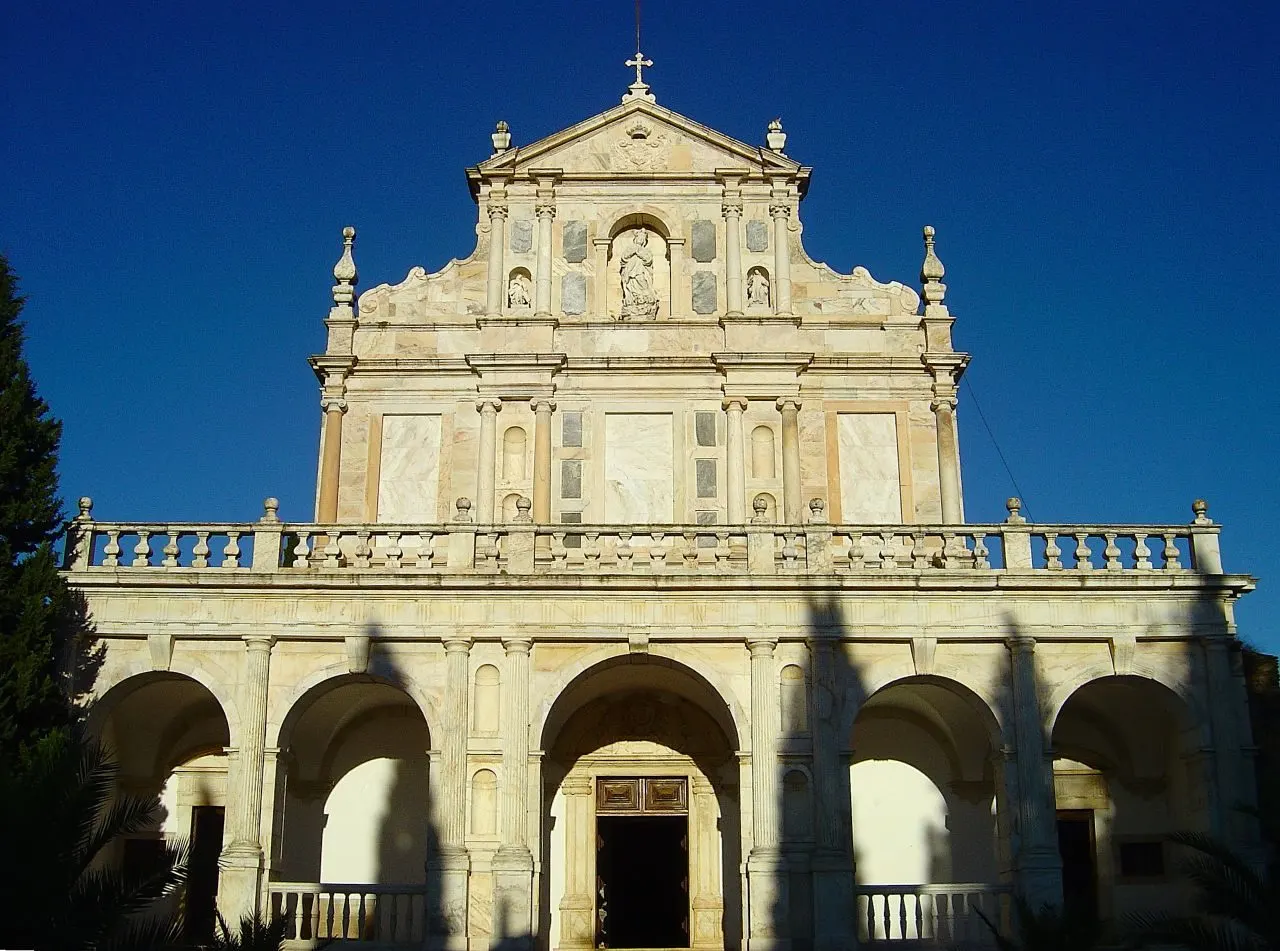
The church façade, in marble, is the best-known element and the only part of the complex that the photograph on this page shows: an arcaded galilee beneath a balustrade and, above it, a central body with a pediment and niche. The Foundation’s text highlights the spaces of a Carthusian house, such as the Pátio da Lavoura, where the lay brothers worked, the monumental cloister, the church and the individual cells, but these areas are not freely open. The organisation of the eremitical layout, with independent cells around a cloister, is what distinguishes Carthusian architecture from that of other monasteries; for comparison, see the general page on monasteries and, in Évora, the Cathedral and the Church of São Francisco.
The architect Luís Ferro, who accompanied the community for ten years, led the 2020 visits and published O Eremitério da Cartuxa de Évora: Arquitetura e vida monástica in 2019. The cloister figures that circulate in guidebooks differ from one another, so I do not repeat them here.
Classification
The Atlas do Património Classificado records the Church of the Charterhouse (Scala Coeli) as a National Monument, by the Decree of 16 June 1910, published in the Diário do Governo no. 136, of 23 June 1910. The same Atlas also records the Monastic Complex of the Charterhouse of Évora as under classification procedure, with the procedure opened by Notice no. 93/2022, published in the Diário da República, 2nd series, no. 96, of 18 May 2022. I found no final classification decision for the complex. I found no reference to a specific UNESCO inscription; the Historic Centre of Évora is a World Heritage Site, but I have not confirmed that the monastery forms part of that inscription.
Planning the visit
As consulted on 5 November 2026, the Fundação Eugénio de Almeida indicated that the church is open every day, from 8:30 to 17:30, and that guided visits take place from Tuesday to Sunday, booked in advance through the Foundation’s “Visite-nos” page. The telephone number given is 266 748 300. Visiting arrangements have changed several times since 2020, so consult the official monastery page before going. As this is a cloistered house, please respect the silence and the areas reserved for the community.
Photograph by Vitor Oliveira, 16 February 2007. Original on Wikimedia Commons, under CC BY-SA 2.0; resized and compressed for the web, without altering the composition.
Frequently asked questions
- When was the Charterhouse of Évora founded?
- According to the Fundação Eugénio de Almeida, seven monks sent by the Order arrived in Évora on 8 September 1587, at the request of D. Teotónio de Bragança, and the community moved to the new house on 15 December 1598. The design is attributed to the architect and military engineer Giovanni Vincenzo Casale.
- Are there still Carthusian monks in Évora?
- No. The Carthusian community, then comprising four monks and one lay brother, left Évora on 31 October 2019. According to the Foundation, on 4 September 2022 nuns of the Institute of the Servants of the Lord and of the Virgin of Matará resumed claustral life in the monastery.
- What is the classification of the monument?
- The Atlas do Património Classificado records the Church of the Charterhouse (Scala Coeli) as a National Monument, by Decree of 16 June 1910 (Diário do Governo no. 136, of 23 June 1910). The Monastic Complex of the Charterhouse of Évora is recorded as under classification procedure, by notice of 18 May 2022.
- Can I visit the Charterhouse?
- As consulted on 5 November 2026, the Fundação Eugénio de Almeida indicated that the church is open daily from 8:30 to 17:30, and guided visits take place from Tuesday to Sunday, booked in advance through the Foundation. Please confirm on the official page.
Sources
- Fundação Eugénio de Almeida — Mosteiro de Santa Maria Scala Coeli (Cartuxa de Évora)
- Fundação Eugénio de Almeida — Fundador e História
- Património Cultural, I.P. — Atlas do Património Classificado e em Vias de Classificação (NINV 2723)
- Diário do Governo — Decreto de 16 de junho de 1910 (n.º 136, 23-06-1910)
- Diário da República — Anúncio n.º 93/2022, 2.ª série, n.º 96, de 18 de maio de 2022
- Observador — Visitas guiadas pela primeira vez na Cartuxa de Évora mostram rituais dos monges (4-08-2020)
- SNPCultura — Mosteiro que acolheu cartuxos em Évora recebe visitas guiadas (2020)
- Portugal Look — O Mosteiro da Cartuxa em Évora (9-03-2025)
- Wikidata — Convento da Cartuxa (Q17117440)
Keep exploring
Heritage nearby
More places to discover from here. Approximate straight-line distances, within 50 km.