Monuments
Montemor-o-Novo Castle
Visit Montemor-o-Novo Castle, a National Monument since 1951: medieval walls, Paço dos Alcaides, churches, Convento da Saudação and an interpretive centre.
- Location
- Montemor-o-Novo, Évora
- Built
- séc. XIII (após o foral de 1203; origem anterior incerta), com obras de D. Dinis e reforços até ao séc. XVII
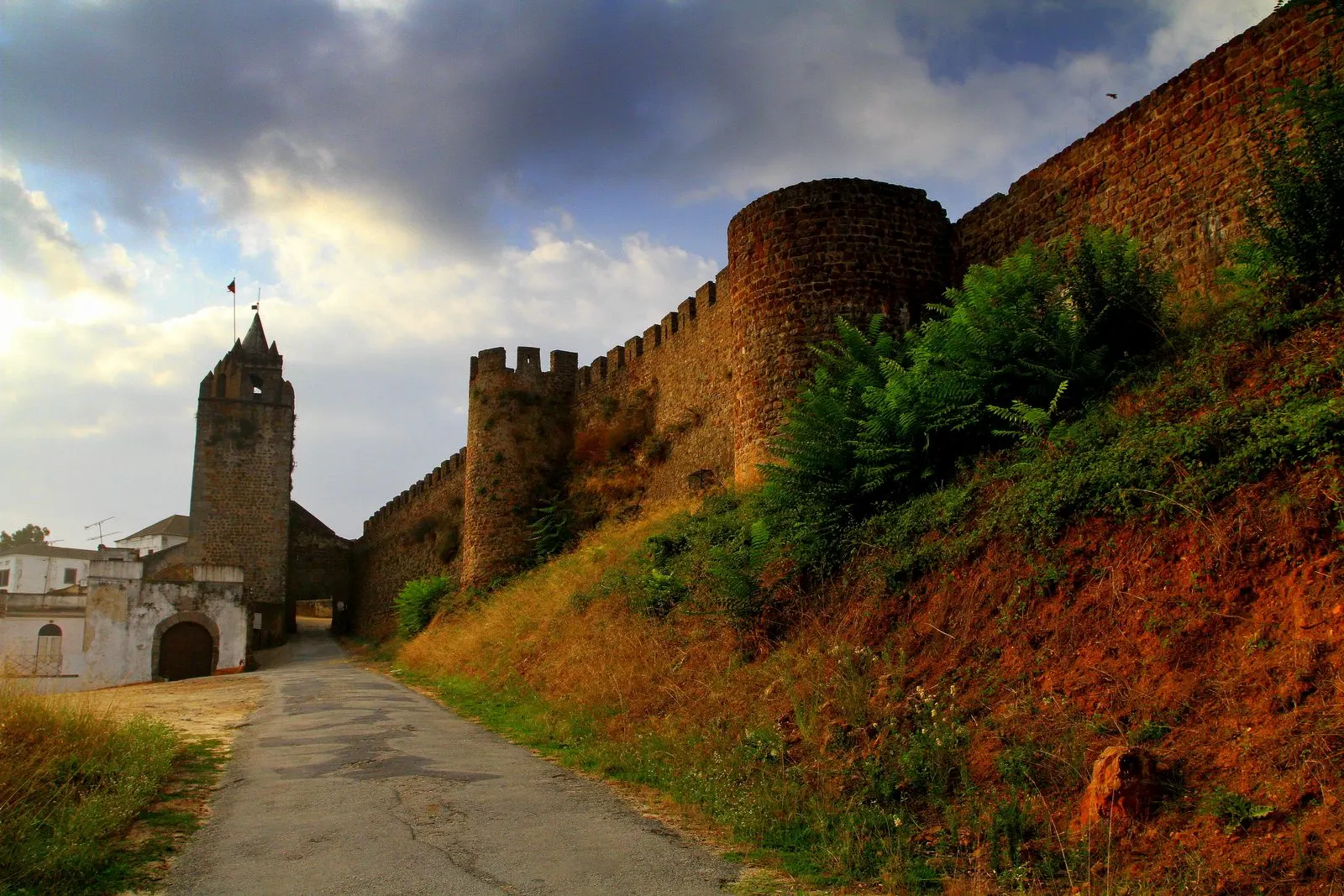
The Montemor-o-Novo Castle is not merely a fortress: it is the entire medieval town, abandoned by its inhabitants and today reduced to walls, towers, churches and ruins atop the hill. On the north side, the modern town descends the slope. Within the enclosure stand the Paço dos Alcaides, three churches, the large Convento da Saudação and an archaeological area with ancient streets and houses. Visiting the castle is therefore a way of walking through the original core of Montemor-o-Novo.
A fortified town on the hilltop
The origin of the fortification is uncertain. The archaeological itinerary of the University of Évora admits two hypotheses: a fortification from the Almohad period (12th century) or a foundation after the charter of 1203, granted by D. Sancho I. The Cultural Heritage Register, I.P. notes that the region had very ancient occupation, including a Romanised castro and possibly a Muslim fortification. The settlement, conquered in the early 13th century and then almost in ruins, was resettled on the basis of the charter, and the alcáçova appears to date from that time.
The major works came with D. Dinis (1279–1325), as in other Alentejo castles, including the construction of the town wall. According to the University of Évora itinerary, this enclosure once had 20 towers. The municipality describes it as one of the largest enclosures in the kingdom, with a perimeter of almost two kilometres and four gates.
In the 14th century, D. João I incorporated Montemor-o-Novo into the lordship granted to D. Nuno Álvares Pereira. In the late 15th century, D. Manuel I entrusted the master stonemason Afonso Mendes de Oliveira with new works. The castle was reinforced again during the War of the Restoration, by order of D. João IV, and was attacked during the French invasions, when it was already in decline.
Cortes, the Paço dos Alcaides and Vasco da Gama
Montemor-o-Novo hosted the Cortes convened by D. Manuel I at the start of his reign. The national register dates them to 1496; the University of Évora itinerary places them in 1495, in the Paço dos Alcaides, shortly after the death of D. João II. The national register explains that from these Cortes, where the voyage to India was reportedly decided, arose the tradition that Vasco da Gama finalised the plans for the expedition here. This is a tradition, not a fact documented in the register.
The Paço dos Alcaides, or alcáçova, was the original core of the castle. It stands on the south side of the enclosure, has a rectangular plan and was protected by two round towers. Today it is in ruins: the itinerary notes that it was severely affected by the 1755 earthquake.
From the old town to the new city
From the 14th century onward, in a climate of peace, inhabitants began to settle outside the walls, in lower areas. The municipality records that, in the 16th century, economic and demographic growth accelerated this movement and the gradual abandonment of the fortified core. The Parish Memoirs of 1758, cited by the University of Évora itinerary, record that only two households were then living in the old town. This is why the castle precinct is now read as an emptied medieval town.
What can be seen within the enclosure
The main access is through the Porta da Vila, also called Porta Nova or de Santarém, on the north side, facing the town. Here stand the Clock Tower, which the municipality presents as a symbol of the town, and the Guard House, bearing the coat of arms of D. Manuel. Of the enclosure’s four gates, three survive: the Vila Gate, the Santiago (or Sun) Gate and the Bispo (or Anjo) Gate; the Évora Gate has disappeared. According to the national register, what survives is essentially the main stretch of the Dionysian wall, roughly triangular in plan, with eleven cylindrical towers and 14th-century barbicans. There are also traces of houses built over the bastions and a cistern in the castle square.
Within the walls are:
- the Church of Santiago, 14th century, which houses the interpretive centre and retains 17th- and 18th-century mural paintings;
- the Church of São João Baptista;
- the ruins of the Church of Santa Maria do Bispo;
- the Convent of Nossa Senhora da Saudação, whose construction, according to the register, began during the reign of D. Manuel, against the walls;
- an archaeological area with streets and houses used between the 13th and 17th centuries, according to the University of Évora itinerary.
The Convento da Saudação
The convent belonged to the Dominican Order. After the dissolution of the religious orders in the 19th century, the State occupied it and used it as an asylum until the 1960s. The 1951 decree already referred to it in these terms: «building of the asylum known as the Infância Desvalida, installed in the former convent». The cultural association O Espaço do Tempo is based in the convent.
In 2018, the State transferred the building to the municipality for 39 years, to restore it for cultural uses. The mayor then described it to Lusa as very degraded, with areas closed to the public. Shoring works costing €1.6 million, funded by the Cultural Heritage Safeguard Fund, followed. On 27 October 2025, RTP, citing Lusa, reported that the rehabilitation had lost its funding from the Recovery and Resilience Plan (PRR). Two tenders had failed to attract bids: one for the complete works, launched in May 2024, and another for the first phase alone. The Cultural Heritage Register, I.P. had committed to studying alternative funding, and O Espaço do Tempo was working in several spaces around the city. When consulted on 5 November 2026, we found no more recent official information on the start of works.
Protection
Decree No. 38 147, published in the Diário do Governo on 5 January 1951, classified the «Castle of Montemor-o-Novo, covering the walls and the buildings located within them» as a National Monument. The decree lists three towers (the keep, the clock tower and the Má Hora tower), three cisterns, a «Moorish slaughterhouse», two chapels, the asylum building in the former convent, ruins of urban buildings, wooded land and public promenade streets, and privately owned plots. It does not name the churches one by one. It is the Cultural Heritage Register, I.P. that identifies the churches of São João Baptista and Santiago, the ruins of Santa Maria do Bispo and the Convent of Saudação as included in the classification. The special protection zone, with a non aedificandi zone, was set by ministerial order of 13 July 1962. The castle is not part of any UNESCO listing. To compare with other fortifications in the region, see the castles of Portugal, the Arraiolos Castle and the Évoramonte Castle.
Saint John of God and the lower town
Montemor-o-Novo is the birthplace of Saint John of God. The saint’s memory is linked above all to the lower town. The municipality states that the parish church was built on the site of his birth and presents it in the section devoted to the historic centre, the town that grew down the north slope from the castle. None of the sources consulted associates the saint with the buildings within the enclosure. A complete visit joins the two parts: the fortified hill and the town that descended from it.
Planning the visit
The interpretive centre is in the Church of Santiago and is a municipal facility on the history of Montemor from Antiquity onward. When consulted on 5 November 2026, the municipal page, last updated on 8 September 2023, listed opening on Tuesday to Sunday. In summer (April to September), hours were 10:00–13:00 and 14:30–18:30; in winter (October to March), 9:00–13:00 and 14:00–17:00. Entrance cost €2.50, and a guided visit of the centre and castle €5, for groups of at least ten people and by reservation. Entrance was free on Sundays and public holidays and for children up to 14 years old, among other cases. As the page has not been updated since 2023, confirm hours and prices by telephone on 266 898 103 before going. The University of Évora itinerary indicates that the castle can be visited by people with reduced mobility.
In the same municipality lies the Escoural Cave, with Palaeolithic rock art. For the regional context, continue to Alentejo.
Photograph by Joaomartinho63, 16 September 2011, for the Wiki Loves Monuments competition. Original on Wikimedia Commons, under CC BY-SA 3.0; resized and compressed for the web, without altering the composition.
Frequently asked questions
- What does the classification of Montemor-o-Novo Castle cover?
- Decree No. 38 147 of 5 January 1951 classified the castle as a National Monument, «covering the walls and the buildings located within them». The Cultural Heritage Register, I.P. identifies within that perimeter the Paço dos Alcaides, the churches of São João Baptista and Santiago, the ruins of the Church of Santa Maria do Bispo and the Convent of Nossa Senhora da Saudação.
- When was it built?
- Its origin is uncertain: it may date from the Almohad period or from the refounding that followed the charter granted by King D. Sancho I in 1203. The alcáçova appears to date from the early 13th century, and the town wall was erected during the reign of D. Dinis. Reinforcements were made in the late 15th century and during the War of the Restoration.
- Where is the interpretive centre?
- In the former Church of Santiago, dating from the 14th century, within the enclosure. When consulted on 5 November 2026, the municipal page (last updated 8 September 2023) listed opening hours from Tuesday to Sunday and an entrance fee of €2.50, free on Sundays and public holidays.
- Is the castle connected to Saint John of God?
- Indirectly. According to the municipality, the parish church of Montemor-o-Novo was built on the site where Saint John of God was born, and the municipality presents it in the historic centre, the town that grew down the north slope from the castle, rather than among the buildings within the enclosure.
Sources
- Património Cultural, I.P. — Castelo de Montemor-o-Novo, abrangendo as muralhas e os imóveis que se encontram dentro delas (70440)
- Património Cultural, I.P. — Atlas do Património Classificado e em Vias de Classificação (NINV 2763)
- Diário do Governo — Decreto n.º 38 147, de 5 de janeiro de 1951
- Município de Montemor-o-Novo — Património Cultural
- Município de Montemor-o-Novo — Centro Interpretativo do Castelo de Montemor-o-Novo
- Universidade de Évora — Roteiros Arqueológicos do Alentejo: Castelo de Montemor-o-Novo
- Diário de Notícias / Lusa — Câmara de Montemor-o-Novo quer recuperar degradado Convento da Saudação (12-09-2018)
- RTP / Lusa — Convento em Montemor-o-Novo perde financiamento do PRR após concursos desertos (27-10-2025)
- Wikidata — Castelo de Montemor-o-Novo (Q5049796)
Keep exploring
Heritage nearby
More places to discover from here. Approximate straight-line distances, within 50 km.