Monuments
Fort of São Filipe (Setúbal)
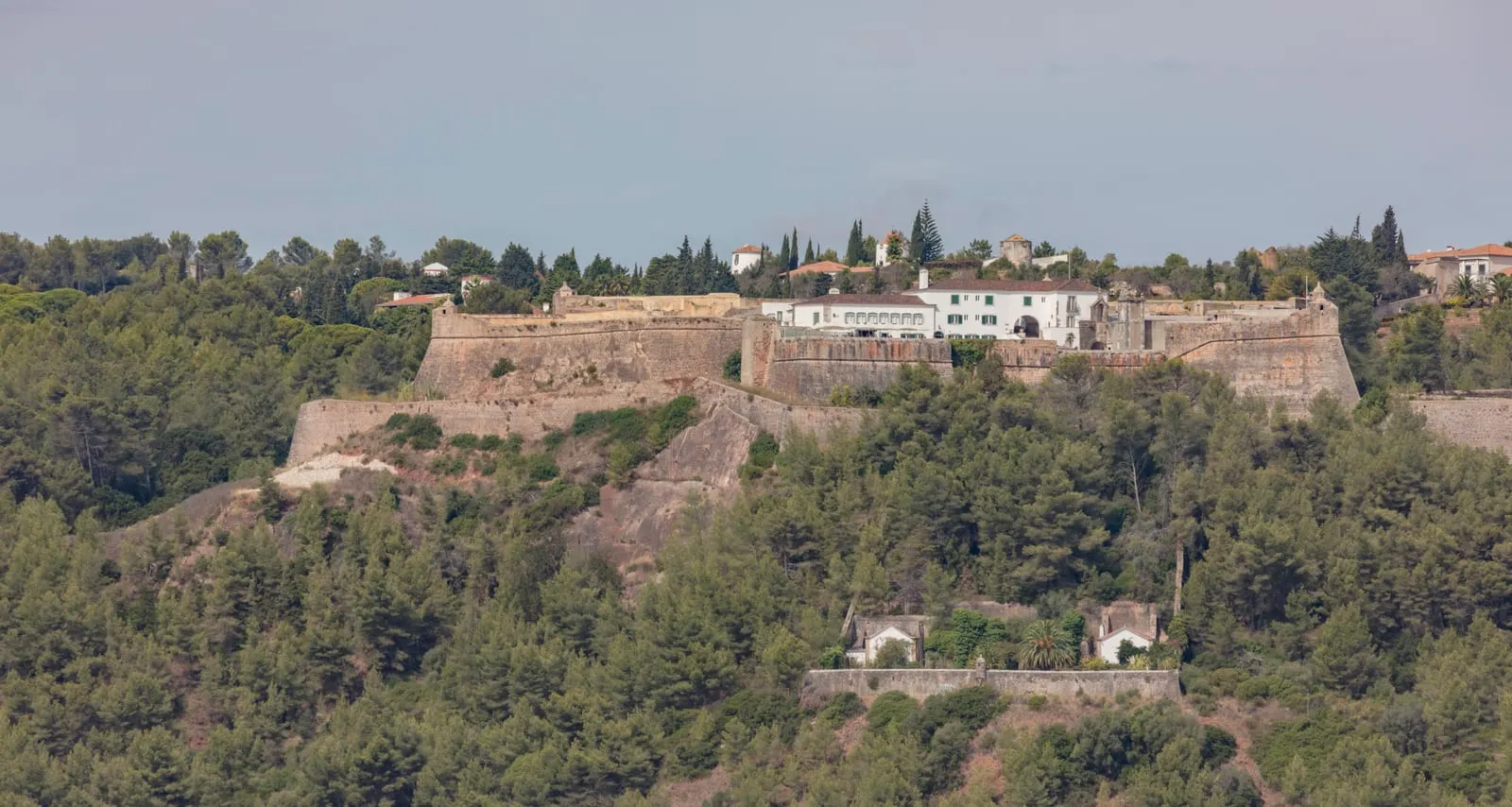
Fortaleza de São Filipe, Setúbal: six-bastion Philippine fort over the Sado, designed by Fratino in 1583, with a tiled chapel and a pousada since 1964.
- Location
- Setúbal, Setúbal
- Built
- Década de 1580 (1582, segundo o município; projeto de 1583)
The Fort of São Filipe, also called the Castle or Fort of São Filipe, stands on a slope to the west of Setúbal, overlooking the bay and the mouth of the Sado. It is a bastioned fortification from the late sixteenth century, commissioned by Philip II of Spain (Philip I of Portugal) shortly after the union of the two crowns. Today it is best known for the viewpoint over the estuary and the Tróia peninsula, the small tile-covered chapel, and the pousada housed within it since 1964.
A Philippine fortress
The national register of Cultural Heritage, I.P. presents the fortress as the result of Philip II’s orders to fortify the coastline protecting Setúbal and the mouth of the Sado. Its authorship has a history of its own. For many years the work was attributed to Filipe Terzi, an Italian engineer in the service of the crown. The Decree No. 23 007 of 1933 itself classifies it as a work “according to tradition” of the “celebrated architect of D. Sebastian and D. Philip II of Spain, the Italian Filipe Tercio”. The national register now indicates that it was designed by Captain Fratino, in 1583. The Municipality of Setúbal places the construction in 1582, during the reign of Philip I. Sources diverge on this starting date, and those we consulted do not state when the work was completed.
The plan is an irregular six-pointed star polygon, with six bastions, set on a steep slope above the sea. On the north side, a second line of walls reinforces the defence. According to the work of Rafael Moreira cited by the register, the scheme recalls that of the Castel Sant’Elmo in Naples.
Defence of the bar or symbol of power?
The fortress’s military importance is debated. Some authors stress the modernity of the work. Others note a mismatch between the adopted plan and the region’s real defensive needs. Rafael Moreira speaks of a “clearly conservative formal choice”: more “an old-fashioned rocca, heavy and impressive, meant to keep a loyal garrison” than a modern fortress. José Custódio Vieira da Silva observed that São Filipe received no strategic improvements over the centuries, unlike the Outão fort, the true defence of the Sado’s mouth.
The national register concludes that the fortress appears as a clear mark of power of the new king, in a territory recently integrated into the Spanish monarchy. The Municipality of Setúbal notes that even at the time there were those who saw the fortification chiefly as a means of controlling the population. Comparison with other bastioned fortresses and the country’s coastal forts helps to understand this difference.
The chapel and the azulejos
The interior originally held the Governor’s House and other military buildings. The small Baroque chapel, dedicated to Our Lady and built during the reign of King John V, survives. The nave is entirely covered in blue-and-white azulejos by Policarpo de Oliveira Bernardes, dated 1736.
From the 1868 fire to the pousada
In 1868, a violent fire destroyed practically all the interior structures. According to the Municipality of Setúbal, the interior was profoundly transformed from 1964 onwards to receive one of the Pousadas de Portugal. The national register also calls it the Pousada de São Filipe.
The slope on which the fort rests is an old problem. The municipality cites cracks opened by the 1755 earthquake, a landslide on the southeast escarpment caused by the 1969 earthquake, stabilisation works in 1986 and, at the end of 2011, a high-risk scenario identified by the National Laboratory for Civil Engineering. According to a 2018 news report, the pousada suspended its activity in 2014 due to slope instability. The same article announced an investment of about 1 million euros to renovate it and expand it from 16 to 35 rooms. The fortress was closed to the public for two years for safety reasons and reopened in March 2017, with some areas fenced off, according to the Lusa news agency.
The Municipality of Setúbal then carried out a structural intervention to prevent rockfalls on the slope, in two phases. The first began in 2018 and appears as completed in 2020 on the municipal page of funded works. The second was contracted in October 2022 and completed in August 2025, at a cost of about 4.18 million euros excluding VAT. It included permanent anchors, micropiles and piles, drains, reinforcement of the interior drainage culvert, and grout injection to fill cracks in the walls. In November 2025, the newspaper O Minho reported the completion of this phase and the restoration of the lighting of the walls facing the Sado.
When consulted on 5 November 2026, we found no official confirmation that the pousada has reopened.
Classification
The fortress is a National Monument under Decree No. 23 007 of 30 August 1933, published in the Diário do Governo, I Series, No. 196. It has a special protection zone, with a non aedificandi zone, set by the Ordinance of 13 July 1962, published in the Diário do Governo, II Series, No. 176, of 27 July 1962. It is not part of any UNESCO inscription.
Preparing a visit
The fort lies to the west of central Setúbal. When consulted on 5 November 2026, we did not find on the Municipality of Setúbal’s website a page with the fortress’s visiting hours. Access conditions, especially after the slope works, should be confirmed with the municipality or the tourist office before going.
The visit pairs well with the historic centre of Setúbal, the Convento de Jesus and the Palmela Castle. For other fortresses, see the castles of Portugal and the region of Lisbon and Tagus Valley.
Photograph by Diego Delso, 12 September 2021. Original on Wikimedia Commons, under CC BY-SA 4.0; resized and compressed for the web, without altering the composition.
Frequently asked questions
- Who designed the Fort of São Filipe?
- For a long time it was attributed to the Italian engineer Filipe Terzi (Philip Terzi), an attribution that the 1933 classification decree itself records as tradition. The national register of Cultural Heritage now indicates that it was designed by Captain Fratino, in 1583.
- Why was it built?
- By order of Philip II of Spain, Philip I of Portugal, which the Municipality of Setúbal dates to 1582, as part of a coastal fortification plan protecting Setúbal and the mouth of the Sado. Several historians read it mainly as an assertion of the new king's power, rather than as an effective piece of the defence of the bar.
- What is its classification?
- It is a National Monument under Decree No. 23 007 of 30 August 1933, and has a special protection zone, with a non aedificandi zone, since the Ordinance of 13 July 1962.
- Is the pousada open?
- We could not confirm this. The pousada installed in the fort suspended its activity in 2014 due to slope instability; in 2018 a renovation project was announced. When consulted on 5 November 2026, we found no official confirmation of reopening. Please check with Pousadas de Portugal.
Sources
- Património Cultural, I.P. — Castelo de São Filipe (69878)
- Património Cultural, I.P. — Atlas do Património Classificado, Castelo de São Filipe (NINV 4049)
- Diário do Governo — Decreto n.º 23 007, de 30 de agosto de 1933 (I Série, n.º 196)
- Município de Setúbal — Obras municipais financiadas
- Município de Setúbal — Intervenção de natureza estrutural para evitar derrocadas na encosta do Forte de São Filipe, fase 2
- Correio da Manhã (Lusa) — Fortaleza de São Filipe, em Setúbal, reabre ao público (29-03-2017)
- Echo Boomer — Pousada de Setúbal vai ter investimento de 1 milhão de euros (27-09-2018)
- O Minho — Grupo de Braga evita derrocadas em forte que remonta ao tempo dos descobrimentos (22-11-2025)
- Wikidata — Castelo de São Filipe (Q8963003)
Keep exploring
Heritage nearby
More places to discover from here. Approximate straight-line distances, within 50 km.