Resources
Lamego Museum
Lamego Museum, the former Episcopal Palace with Grão Vasco panels from the Sé, Flemish tapestries and carved chapels, is closed for works since May 2025.
- Location
- Lamego, Viseu
- Built
- Reforma do Paço Episcopal sob o bispo D. Manuel de Vasconcelos Pereira (1772–1786); museu criado em 1917
The Lamego Museum occupies the former Episcopal Palace, in the historic centre of Lamego, next to the Sé (cathedral). It is one of the centenary museums born of the Law of Separation of the State from the Churches. It holds 18 national treasures: the panels Grão Vasco painted for the cathedral, sixteenth-century Flemish tapestries, seventeenth-century azulejo panels and a medieval tomb chest. Since 24 May 2025 it has been closed to the public for works; read the section on visiting before planning your trip.
A Baroque palace of Port wine
The present building results from a extensive refurbishment carried out by D. Manuel de Vasconcelos Pereira, Bishop of Lamego between 1772 and 1786. The museum’s chronology places the rebuilding in 1776. The museum links this campaign to the Baroque innovations arriving in the region, in a period of prosperity brought by the Port wine trade.
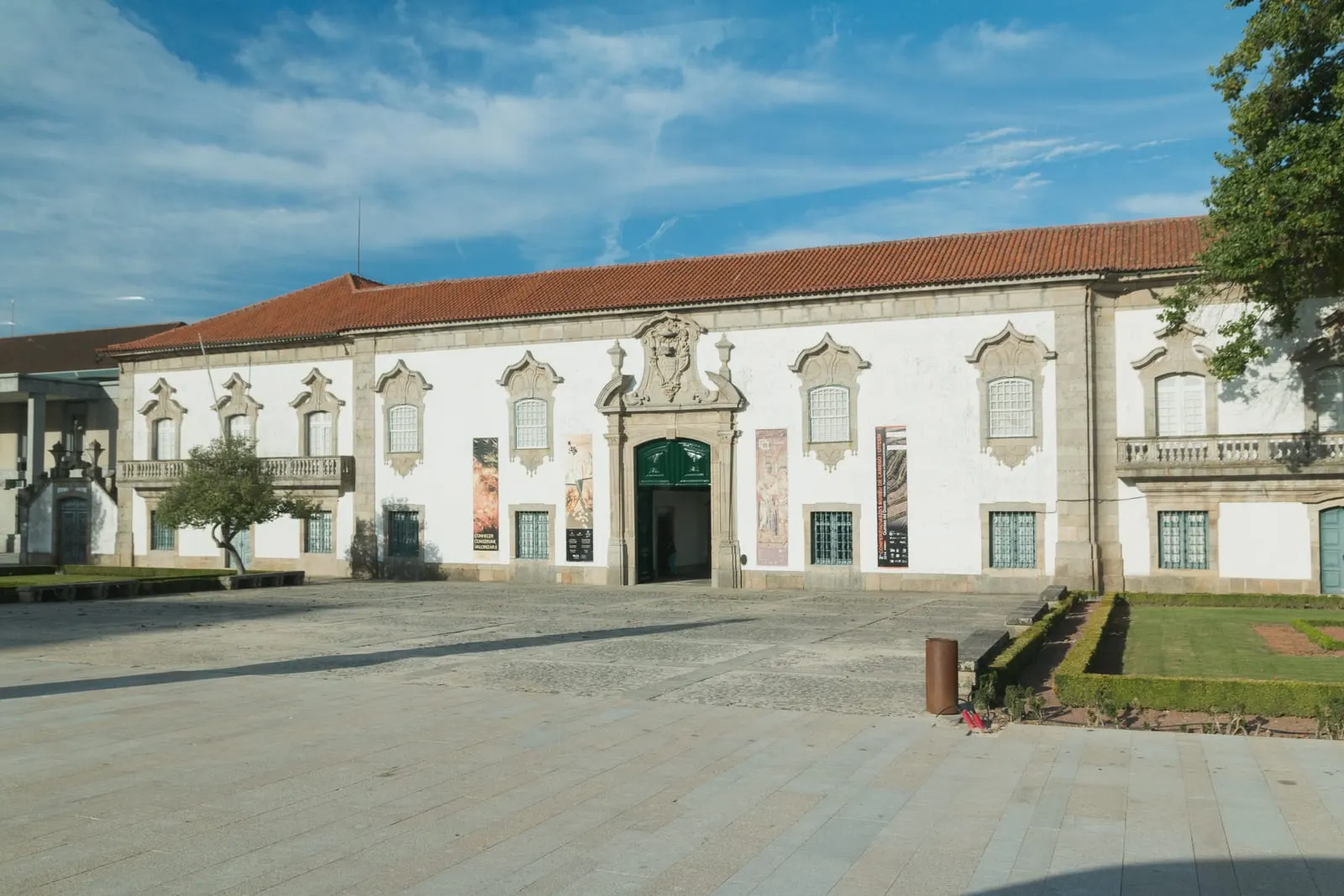
The façade is long and divided into three bays by plain granite pilasters. In the end blocks, three balcony windows open on each side, with pediments and aprons of counter-curved lines, joined by a continuous balustrade. In the central body, the portal has stipes, an interrupted curved pediment and the episcopal arms. To the north survives the door of the former public chapel. At the other end stands the iron gate of the Sacrament chapel of the Sé, placed there in 1969.
The building is organised around a central courtyard. The museum itself warns that little of the eighteenth-century rebuilding survives in the interior. It was heavily modified in the early twentieth century and, after the confiscation of 1911, underwent regular restorations that altered the interior spaces.
From sacred art museum to State museum
The idea of a museum came from Bishop D. Francisco José Ribeiro de Vieira e Brito, who governed the diocese between 1901 and 1922. He wished to install a museum of sacred art in the palace and began gathering works scattered across the diocese. The proclamation of the Republic in 1910 interrupted the work. In 1911, the palace and its contents passed to the State, and the Lamego Municipal Chamber decided to create an art museum with the collection assembled by the prelate.
The museum was created by Decree No. 3047 of 5 April 1917. In 1918, the pieces were handed over to the first director, João Amaral, and the museum was inaugurated. Today it is part of the network of Museus e Monumentos de Portugal.
The national treasures
In 2006, Decree No. 19/2006 of 18 July classified 18 pieces from the museum as national treasures, the highest form of protection for movable heritage. The museum highlights four groups.
The panels by Grão Vasco. Five panels from the altarpiece of the high altar of Lamego Cathedral, painted by Vasco Fernandes in the first decade of the sixteenth century. It is the same painter who gives his name to the Grão Vasco National Museum, in Viseu. The two collections complement each other for those studying Portuguese Renaissance painting.
The Flemish tapestries. They were woven in Brussels in the first half of the sixteenth century. The museum identifies the “Oedipus Series”, “The Judgement of Paris” and “The Temple of Latona”.
The azulejos and the tomb chest. The azulejo panels date from the seventeenth century. The fourteenth-century tomb chest is believed to have received the remains of D. Teresa Anes de Toledo, third wife of Count Pedro Afonso.
Painting, sculpture and gilded woodwork chapels
The painting collection comprises about 250 works, from the sixteenth to the late eighteenth century. Besides Grão Vasco, it includes sixteen paintings by André Reinoso and workshop. The museum considers it one of the largest seventeenth-century painting ensembles by a single author in Portuguese museums. There is also European painting, chiefly Flemish and Dutch, gathered by the bishops in the palace’s “great hall of paintings”. The perspective ceiling of the private chapel, from the late eighteenth century, is the museum’s only example of mural painting.
The sculpture ranges from the Roman period, with funerary stelae, to the early twentieth century. From the medieval period comes a nucleus of wooden sculpture from São Pedro de Balsemão, which the museum considers a rare testimony.
The museum also holds a set of chapels lined with gilded woodwork, brought from the extinct Convent of the Chagas of Lamego, together with the paintings of their decorative programmes. The collection is completed by furniture, goldsmithing, vestments, means of transport, ceramics, prints, drawings and photography.
Classification and World Heritage
The former Episcopal Palace has no listing of its own in the Atlas do Património Cultural, I.P. The Atlas places it within the special protection zone of Lamego Cathedral, a national monument, defined by Portaria of 6 April 1960.
The building also lies in the buffer zone of the Alto Douro Wine Region, a World Heritage Site; for this zone the Atlas cites Portaria No. 122/2024. A buffer zone protects the surroundings of the inscribed property but does not form part of it: the museum is not itself a World Heritage Site.
Planning your visit
The museum has been closed to the public since 24 May 2025 for requalification works funded by the Recovery and Resilience Plan (PRR). When consulted on 5 November 2026, the museum’s website and the Museus e Monumentos de Portugal page still carried the closure notice and gave no reopening date. For that reason, no opening hours or prices are given here.
During the works, the museum’s courtyard hosted the programme “Pátio das Culturas”, from 11 July to 16 August 2026. Before going, confirm the situation on the official museum website or by telephone at +351 254 600 230.
Even with the museum closed, the Sé de Lamego is a few steps away. The town also offers the Sanctuary of Nossa Senhora dos Remédios.
Photograph by Daniel Villafruela, September 2014. Original on Wikimedia Commons, under CC BY-SA 4.0; resized and compressed for the web, without altering the composition.
Frequently asked questions
- Is the Lamego Museum open?
- No. The museum has been closed to the public since 24 May 2025 for requalification works under the Recovery and Resilience Plan (PRR). When consulted on 5 November 2026, the official pages did not indicate a reopening date.
- When was the Lamego Museum created?
- It was created by decree of 5 April 1917 and opened in 1918, in the former Episcopal Palace, which the State had confiscated in 1911 following the Law of Separation of the State from the Churches.
- What works by Grão Vasco does the museum hold?
- Five panels from the altarpiece of the high altar of Lamego Cathedral, painted by Vasco Fernandes in the first decade of the sixteenth century. They have been national treasures since 2006.
- Is the building listed?
- The Episcopal Palace has no listing of its own in the Atlas do Património Cultural. It lies within the special protection zone of Lamego Cathedral and the buffer zone of the Alto Douro Wine Region, which does not make it part of the property inscribed by UNESCO.
Sources
- Museu de Lamego — O Museu (história e arquitetura)
- Museu de Lamego — Página inicial (cronologia)
- Museu de Lamego — Coleção
- Museu de Lamego — Visitar (aviso de encerramento)
- Museu de Lamego — Pátio das Culturas, julho e agosto no pátio do museu (09-07-2026)
- Museus e Monumentos de Portugal — Museu de Lamego
- Património Cultural, I.P. — Atlas do Património Classificado e em Vias de Classificação (camadas de imóveis e ZEP)
- Património Cultural, I.P. — Sé de Lamego (71134)
- Wikidata — Museu de Lamego (Q10333845)
- UNESCO — Alto Douro Wine Region (1046)
Keep exploring
Heritage nearby
More places to discover from here. Approximate straight-line distances, within 50 km.

Resources for research
Find the sources. Follow the story.
Guides to researching buildings, exploring museum collections and understanding heritage protection.
SIPA
Get to know the architectural inventory, building records and documentary archive.
Read the guideMuseum collectionsMatrizNet
Explore the museum catalogue and records of works, materials, authorship and provenance.
Read the guideHeritage protectionHeritage classification
Understand cultural property categories and the levels of national, public and municipal interest.
Read the guide