Monuments
Freixo Palace
Freixo Palace, in Porto: a Baroque palace attributed to Nasoni, later a milling factory, restored and now the Pestana hotel. National Monument since 1910.
- Location
- Porto, Porto
- Built
- Meados do século XVIII
- Style
- Barroco
The Freixo Palace stands on the north bank of the Douro, in Campanhã, in the eastern part of Porto, and is attributed to the Tuscan architect Nicolau Nasoni. Porto’s tourist office considers it one of the most remarkable examples of Portuguese Baroque civil architecture. It has one feature that shapes any visit: since 2009 it has been a hotel, housed in the palace and in a former milling factory beside it.
A Nasoni palace by the river
Nasoni arrived in Portugal in 1725 to work on the Cathedral of Porto and eventually settled in the city, where he designed the Church and Tower of the Clérigos; Pestana also credits him with the Mateus Palace. Freixo was built for Jerónimo de Távora e Noronha, linked to the Cathedral of Porto (Pestana describes him as the cathedral’s dean). Porto’s tourist office and Pestana date the work to the mid-18th century; none of the sources I consulted gives an exact start or completion date, so I do not state one here.
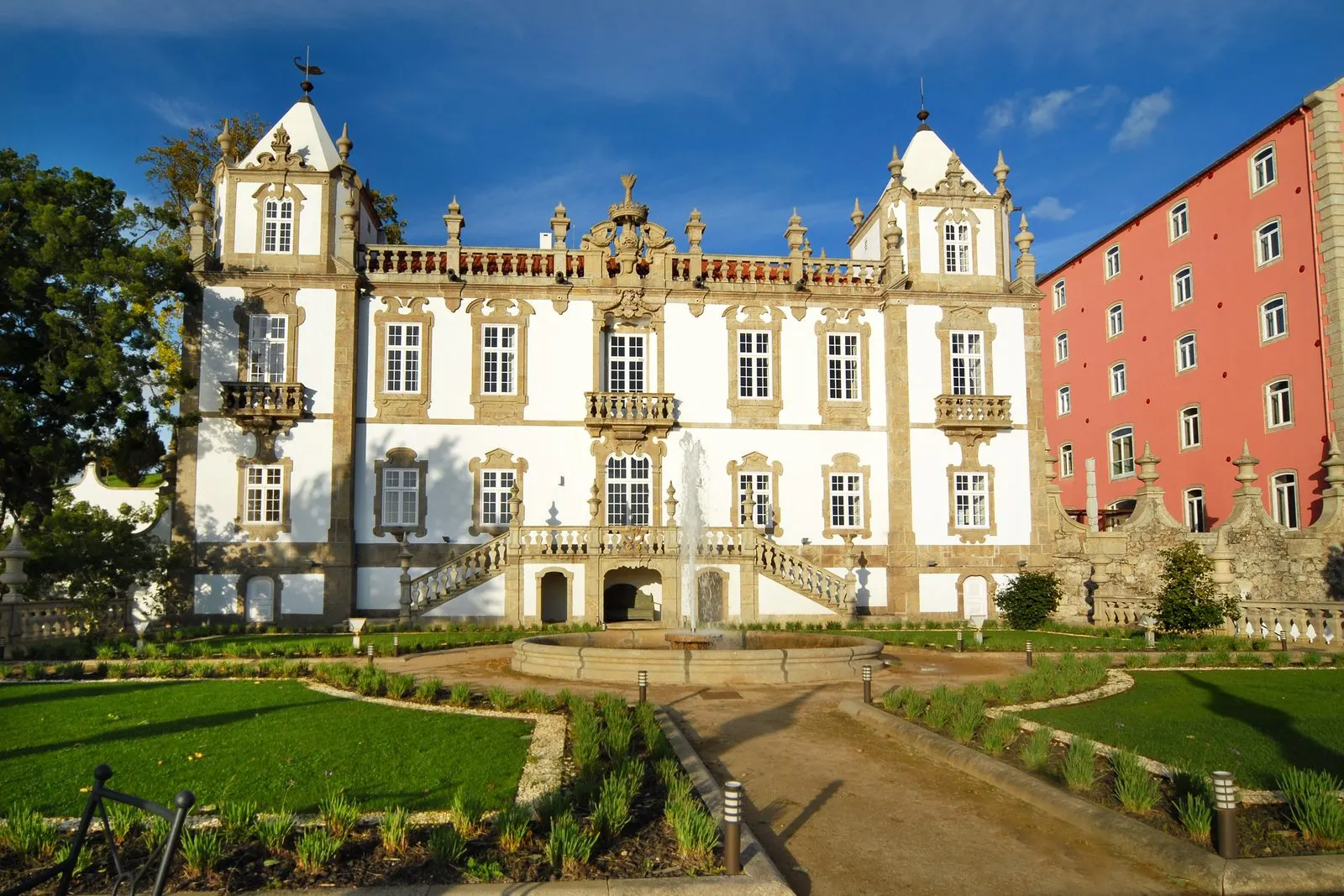
In the photograph illustrating this page, the building’s layout is clear: a compact façade with two pyramid-capped towers, a balustrade with pinnacles, window surrounds with recessed mouldings, and a double staircase descending to the garden, with a basin at its centre. The contrast between the exposed granite and the white render emphasises the ornamentation; for the stylistic context, see Baroque architecture in Portugal.
From noble house to factory and hotel
The later history is that of a property that changed function several times. Pestana notes that António Afonso Velado, one of the subsequent owners, made the interiors more opulent. In the twentieth century the palace passed to the Companhia de Moagem Harmonia, which built a factory in the grounds, using river water to power steam machinery. The industrial building still stands beside the palace, where the guest rooms now are, and it forms part of how the site is read.
The Porto City Council acquired the complex in the 1980s. The restoration was directed by the architect Fernando Távora; sources differ on the timetable (Pestana places it in the decade after the purchase, while others indicate works between 2000 and 2003), so it is worth checking the official record before citing dates. Pestana states that the complex was ceded to the group in 2006 and that it opened three years later as the largest Pousada in Portugal; today it belongs to the group’s hotel collection.
Legal protection
The Cultural Heritage register, through the Atlas of Classified Heritage, identifies Freixo Palace as a National Monument, classified by decree of 16 June 1910, published in the Diário do Governo no. 136 of 23 June 1910. The Atlas also records a special protection zone set by the Ministerial Order of 24 March 1949. I found no link to a UNESCO inscription: Freixo is not referred to as a component of the Historic Centre of Porto, which is a separate inscription.
How to visit
Porto’s tourist office describes the complex as two buildings connected to each other: the palace, which houses the restaurant, the bar, reception rooms and meeting rooms, and the former Harmonia factory, which holds the guest rooms (87, according to the same source). Because the palace operates as a hotel, access for non-guests depends on the operator. When I consulted sources on 5 November 2026, I found no public visiting hours or entrance ticket: what the operator advertises are hotel services, including the Palatium restaurant and the Nasoni bar, described in a Pestana text updated in May 2025. To dine, have a coffee or ask about a visit to the building, contact the hotel directly.
The address given is Estrada Nacional 108, 4300-316 Porto, in the parish of Campanhã. The telephone number listed by Pestana is +351 229 766 450. Please confirm it, and the conditions of access to the interior, on the hotel’s page.
Photograph by António Amen, dated 1 November 2010. Original on Wikimedia Commons, under CC BY-SA 3.0; resized and compressed for the web, without altering the composition.
Frequently asked questions
- Who designed Freixo Palace?
- It is attributed to the Tuscan architect Nicolau Nasoni, who arrived in Portugal in 1725. It was built for Jerónimo de Távora e Noronha, linked to the Cathedral of Porto, in the mid-18th century.
- Is Freixo Palace a hotel today?
- Yes. Ceded by the Porto City Council to the Pestana group in 2006, it opened as a pousada three years later and now operates as the Pestana Palácio do Freixo hotel, with guest rooms in the former milling factory beside it.
- What is the heritage status of Freixo Palace?
- It is a National Monument, classified by decree of 16 June 1910, published in the Diário do Governo no. 136 of 23 June 1910. It is not part of any UNESCO inscription.
- Can it be visited without being a guest?
- When I consulted sources on 5 November 2026, I found no public visiting hours. The restaurant and bar are hotel services; contact the operator to confirm access to the building.
Sources
- Património Cultural, I.P. — Atlas do Património Classificado e em Vias de Classificação (NINV 3757, Palácio do Freixo)
- Diário do Governo — Decreto de 16 de junho de 1910 (I Série, n.º 136, 23-06-1910)
- Pestana Hotel Group — Pestana Palácio do Freixo, um monumento com vista para o Douro
- Pestana Hotel Group — Pestana Palácio do Freixo (página do hotel)
- Visit Porto — Pestana Palácio do Freixo
- Wikidata — Palácio do Freixo (Q9054487)
- Wikipédia — Palácio do Freixo (apenas como ponteiro)
Keep exploring
Heritage nearby
More places to discover from here. Approximate straight-line distances, within 50 km.