Monuments
Maria Pia Bridge (Porto)
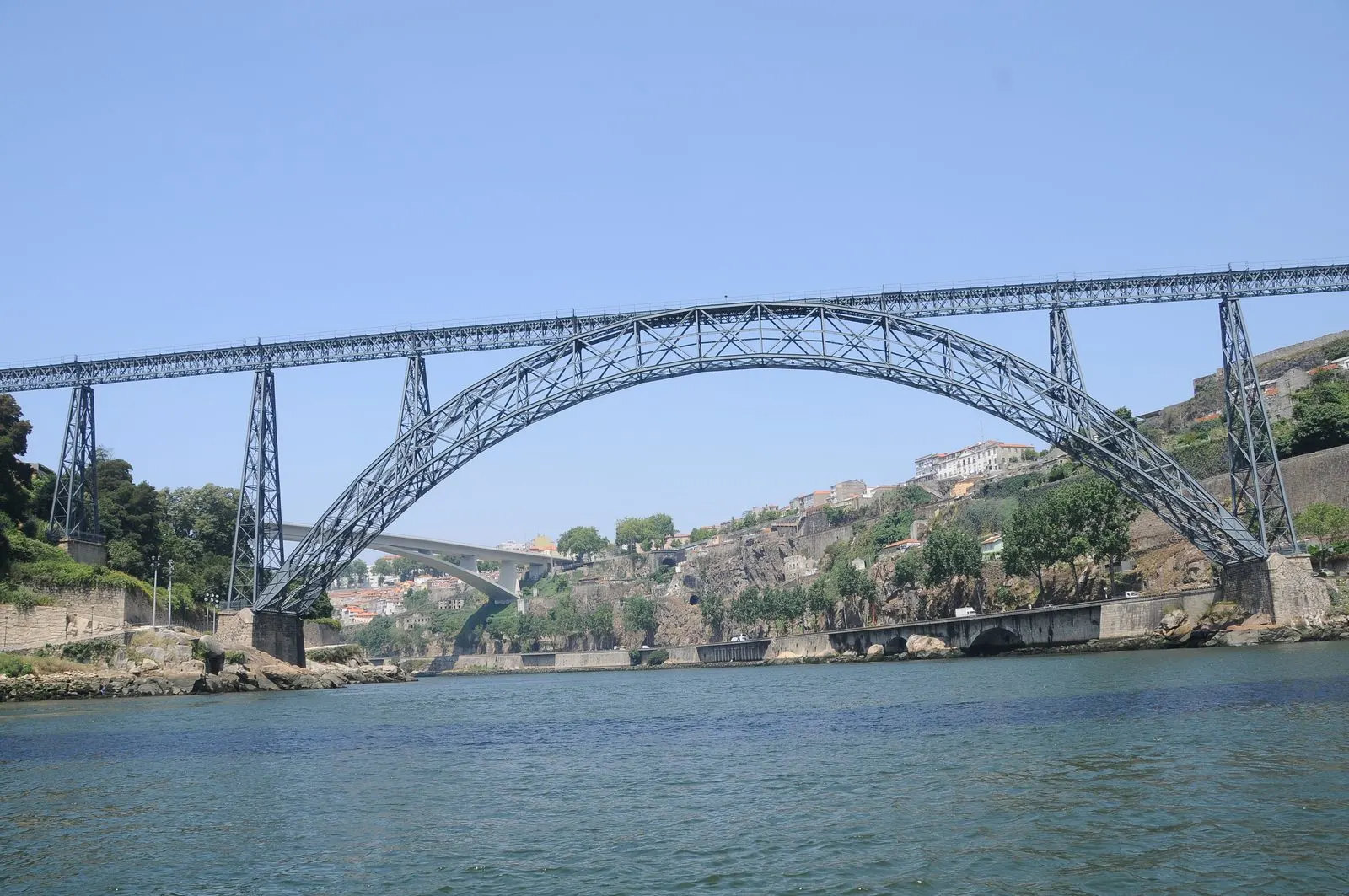
D. Maria Pia Bridge, between Porto and Gaia: a 160 m iron arch by the Eiffel firm, opened in 1877, closed to trains in 1991 and a National Monument.
- Location
- Porto / Vila Nova de Gaia, Porto
- Built
- 1876–1877
- Style
- Arquitetura do ferro
The Ponte de D. Maria Pia crosses the Douro between Fontainhas, in Porto, and Vila Nova de Gaia, upstream of the Ponte Luiz I. It was the bridge that brought the Linha do Norte railway into the city and served the line for almost 114 years. It is now out of service, but its iron arch remains one of the most recognisable images of nineteenth-century engineering in Portugal.
Why the Douro had to be crossed
The railway reached Gaia, at the Devesas station, in 1864. The line stopped on the south bank: to link Lisbon with Porto, and Porto with the Minho and Douro lines, the river still had to be overcome. The national heritage record notes that the terminus in Gaia diverted part of the commercial activity to the other bank, which made the crossing a priority for the city.
Among the solutions studied, CP refers to three proposals, and the one chosen was that presented by Eiffel & Cie, following the so-called “Seminary alignment”. Infraestruturas de Portugal dates the award to 22 June 1875, made by the Companhia Real dos Caminhos de Ferro, the company responsible for the Linha do Norte. The Cultural Heritage register highlights the role of two Portuguese engineers in the process, Manuel Afonso de Espregueira and Pedro Inácio Lopes; the latter, according to CP, followed the study and construction of the bridge on behalf of the Companhia Real.
A 160-metre arch
Work began on 5 January 1876 and finished on 30 October 1877. Load tests followed between 31 October and 2 November, with heavy locomotives hauling loaded wagons. The inauguration took place on 4 November 1877, with King D. Luís and Queen D. Maria Pia present; her name replaced the designation “D. Fernando” used during the works.
The structural solution is what makes the bridge remarkable. A two-hinged arch with a 160-metre span supports, through lattice piers, a railway deck 354 metres long, about 61 to 62 metres above mean water level (the national record and CP give differently rounded figures). There are no piers in the riverbed. Infraestruturas de Portugal states that, at the time of its inauguration, it was the bridge with the largest iron arch in the world.
The bridge is known as a work by Gustave Eiffel, but the project came from a firm with several engineers. Théophile Seyrig, Eiffel’s partner, is listed as the designer of the Maria Pia in engineering databases such as Structurae, and the Ordem dos Engenheiros (Northern Region) published a monograph in 2005 titled Ponte Maria Pia: a obra-prima de Seyrig (The Maria Pia Bridge: Seyrig’s masterpiece). Seyrig later became the engineer of the Ponte Luiz I. In 1878, according to CP, the Eiffel firm received a major prize for the construction at the Paris Universal Exhibition.
From main line to closure
The bridge had a single track. As the weight of trains and the volume of traffic grew, this feature increasingly restricted circulation, and CP notes that replacement had been under consideration since the mid-twentieth century. To keep the structure maintained, the Companhia Real created the Ovar Metalwork Workshop, which later worked on other railway bridges until the 1990s.
The replacement was the Ponte de São João, in reinforced and prestressed concrete, designed by engineer Edgar Cardoso. It entered service on 24 June 1991, and the same day the Maria Pia was closed to rail traffic. The two bridges stand side by side, which allows a direct comparison between nineteenth-century iron engineering and late twentieth-century concrete engineering.
Classification and recognition
The bridge is a National Monument under Decree No. 28/82, published in the Diário da República on 26 February 1982. In 1990, the American Society of Civil Engineers awarded it the title of international historic landmark in civil engineering, presenting it as the first major work of the Eiffel firm.
The Ponte de D. Maria Pia is not part of the designation of the property inscribed by UNESCO in Porto, the Centro Histórico do Porto, Ponte Luiz I e Mosteiro da Serra do Pilar, which names only the Ponte Luiz I. The Maria Pia’s protection results from its own national classification.
What is happening to the bridge today
The bridge still belongs to the network managed by Infraestruturas de Portugal. In November 2023, the company stated that it carried out regular inspections and the maintenance work needed to ensure structural safety. Reuse plans have followed one another without being carried out: in 2004 a protocol was signed with the Porto and Gaia city councils to convert it into a cycle path, which was never fulfilled; in August 2022, Infraestruturas de Portugal said it would examine with the two municipalities its use as a pedestrian and cycle route.
When the municipalities presented, on 23 June 2026, the project for a new pedestrian and cycle bridge between the Ponte Luiz I and the Ponte da Arrábida, they said they were still “studying alternatives” for the Maria Pia. In the consultation of 5 November 2026, we found no approved project and no works schedule to reopen it.
Seeing the bridge
The bridge is not open to pedestrians, so the visit is made from outside. The banks of the Douro at Fontainhas and the Gaia side allow you to see the arch in profile and the Ponte de São João alongside it. To place the structure in context, continue through the country’s metal bridges and iron architecture, which includes railway stations such as the Estação de São Bento, and through industrial heritage.
Photograph by Joseolgon, 24 July 2012. Original on Wikimedia Commons, under CC BY-SA 3.0; resized and compressed for the web, without altering the composition.
Frequently asked questions
- Who built the Ponte de D. Maria Pia and when?
- Construction was awarded in 1875 by the Companhia Real dos Caminhos de Ferro to the firm Eiffel & Cie, led by Gustave Eiffel. The works ran from 5 January 1876 to 30 October 1877, and the bridge was inaugurated on 4 November 1877 in the presence of King D. Luís and Queen D. Maria Pia.
- Do trains still cross the bridge?
- No. The bridge was closed to rail traffic on 24 June 1991, the day the Ponte de São João, designed by engineer Edgar Cardoso, entered service and took over the crossing of the Douro on the Linha do Norte.
- Is the Ponte de D. Maria Pia listed?
- Yes. It is a National Monument under Decree No. 28/82, published in the Diário da República on 26 February 1982. In 1990 it was also given the title of international historic landmark in civil engineering by the American Society of Civil Engineers.
- Can the bridge be crossed on foot?
- As of the consultation on 5 November 2026, no. The bridge remains out of service and is managed by Infraestruturas de Portugal; in June 2026 the municipalities of Porto and Gaia said they were still studying alternatives for its future.
Sources
- Património Cultural, I.P. — Ponte de D. Maria Pia (70405)
- Património Cultural, I.P. — Atlas do Património Classificado e em Vias de Classificação (NINV 3762)
- Diário da República — Decreto n.º 28/82, de 26 de fevereiro
- CP — Comboios de Portugal — A Ponte Maria Pia
- Infraestruturas de Portugal — Ponte Maria Pia sobre o Douro celebra 146 anos
- Infraestruturas de Portugal — Beneficiação da Ponte de São João na Linha do Norte
- American Society of Civil Engineers — Ponte Maria Pia Bridge
- Structurae — Théophile Seyrig
- Observador / Lusa — Deputados do PS questionam Governo sobre reabertura da Ponte Maria Pia no Porto (17-03-2023)
- Diário de Notícias — Porto e Gaia vão ter nova ponte pedonal e ciclável sobre o Douro até 2029 (23-06-2026)
- Wikidata — Ponte de D. Maria Pia (Q1550899)
Keep exploring
Heritage nearby
More places to discover from here. Approximate straight-line distances, within 50 km.