Monuments
Palácio e Quinta da Bacalhoa
Palácio e Quinta da Bacalhoa, Azeitão: Brás de Albuquerque's Renaissance house (1528-1554), 16th-century azulejos, National Monument. Paid guided tour.
- Location
- Vila Nogueira de Azeitão, Setúbal
- Built
- 1528–1554 (obra principal de Brás de Albuquerque, sobre casas do século XV)
- Style
- Renascimento
The Palácio e Quinta da Bacalhoa stands in Vila Fresca de Azeitão, in the municipality of Setúbal. Also known as the Palácio dos Albuquerques, it is a sixteenth-century country residence whose plan, galleries and garden make it, according to the official register, one of the earliest and most beautiful examples of civil architecture of the Renaissance in Portugal. It now belongs to a wine estate and can be visited with a guide.
From the Constable’s houses to Brás de Albuquerque
According to the Património Cultural register, it was in 1427 that Infante D. João, Master of the Order of Santiago and Constable of the kingdom, had houses built on a large estate in Azeitão. Some Gothic ribbed vaults survive from them. The estate passed to his daughter, D. Brites, and to her husband, Infante D. Fernando, parents of the future King D. Manuel, who remodelled it with a crenellated enclosure and Levantine-pattern azulejo cladding, still visible in an outbuilding.
In 1528 the estate, then called Villa Feyxe or Vila Fresca, was sold to Brás de Albuquerque, son of Afonso de Albuquerque and owner of the Casa dos Bicos in Lisbon. The register attributes most of the present building to him, although it acknowledges that it is difficult to know what already existed. Between 1528 and 1554 a remodelling in the classical taste took place; 1554 is the date of an inscription on a doorway and marks the end of the main works. According to the same register, the name Bacalhoa derives from Bacalhau, the surname of D. Jerónimo Manuel, an owner at the end of the sixteenth century.
The palace and its pavilions
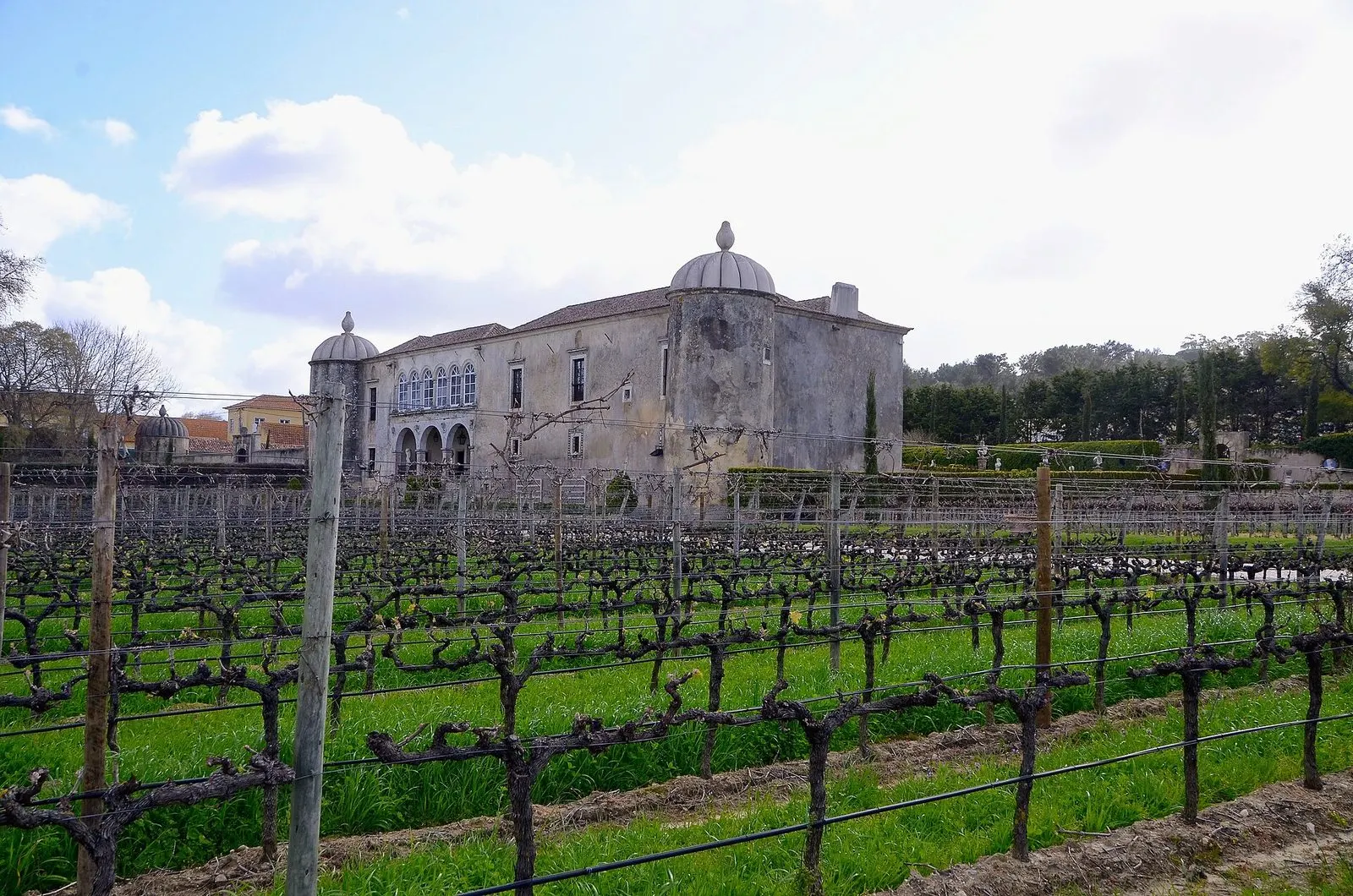
The house has an L-shaped plan, which the register links to the novelties Albuquerque is thought to have brought back from a journey to Italy in 1521–1522. Visitors enter through a walled courtyard in front of the main façade, which has a gallery of thirteen arches on plain columns. Inside the angle of the L lies the garden, with a box-hedge labyrinth. Against the south wall stands the Casa de Fresco, formed of three towers linked by arcaded galleries above the great pool. Halfway across the estate, along the wall, are two garden pavilions, the Casa da Índia and the Casa das Pombas.
The register highlights military elements, such as the crenellated enclosure and the cylindrical towers with fluted domes, which suggest the involvement of an architect of fortresses in India. It also mentions medallions by Della Robbia on the wall of the pool and others attributed to Nicolau de Chanterene. The authorship of the project is not established: the register notes that it was once attributed to Andrea Sansovino, but considers the circle of Francisco de Arruda more plausible. The decorative themes are classical, drawing on heroes of antiquity and mythological references.
Azulejos
What the official source documents is the following. In an outbuilding of the house there are fifteenth-century azulejos of Levantine pattern. The garden pavilions have sixteenth-century azulejo cladding; on the pavilion above the pool is a panel dated 1565 and signed by Eneas Vito, an artist who worked at Fontainebleau, which the register’s images identify as Susanna in the Bath. The Bacalhôa presents the lakeside house as the site of the first dated azulejo in Portugal; this is a claim made by the company, which we did not find in the official register. For the context of these panels, see azulejo and majolica azulejo.
Classification
The Palácio da Bacalhoa was classified as a National Monument by decree of 16 June 1910 (Diário do Governo No. 136, 23 June 1910). Decree No. 2/96 of 6 March 1996 changed the designation to Palácio e Quinta da Bacalhoa, and Rectification Notice No. 10-E/96 corrected the district from Lisboa to Setúbal. The special protection zone, with a non aedificandi zone, was set by Ordinance No. 255/96 of 13 November 1996; the register also lists an earlier ordinance of 15 July 1949.
Ownership and visits
In the company’s chronology, the palace and estate were bought in 2000 by José Berardo, and the visit is now run by Bacalhôa Vinhos de Portugal, which includes it in its wine tourism offer. The current legal ownership has not been confirmed.
When consulted on 5 November 2026, the Bacalhôa website listed guided visits at 10:00 and 15:00 (other times on request), with an average duration of 1 hour 30 minutes and availability for those who do not book in advance. The shop opens from 10:00 to 18:30. The palace closes on Sundays and national holidays, as well as on 1 January and 25 December. The palace ticket cost 13 euros, the Adega Museu ticket 7 euros, and the combined ticket 16 euros, with free entry for children up to 12 and a minimum of two people. The address is Estrada Nacional n.º 10, 2925-901 Vila Nogueira de Azeitão; confirm everything at bacalhoa.pt or at [email protected]. For the wider context of noble houses, see solares e casas senhoriais.
Photograph by Mª Teresa Sousa, 31 March 2018. Original on Wikimedia Commons, under CC BY-SA 4.0; resized and compressed for the web, without altering the composition.
Frequently asked questions
- Who had the Bacalhoa built?
- Most of what can be seen is due to Brás de Albuquerque, son of the Viceroy of India Afonso de Albuquerque, who bought the estate in 1528. According to the Património Cultural register, the main works were completed in 1554, a date recorded in an inscription on a doorway. Before him, the property had houses built in 1427 by Infante D. João, Constable of the kingdom.
- Is it listed?
- Yes, as a National Monument. The Palácio da Bacalhoa was classified by decree of 16 June 1910; Decree No. 2/96 of 6 March 1996 changed the designation to Palácio e Quinta da Bacalhoa.
- Can it be visited?
- Yes, on guided tours. When consulted on 5 November 2026, the Bacalhôa website listed visits at 10:00 and 15:00 (other times on request), with an average duration of 1 hour 30 minutes, closed on Sundays and public holidays, and a ticket of 13 euros for the palace.
- Is the palace publicly owned?
- No, it is not a state-managed monument: the visit is organised by the wine company Bacalhôa Vinhos de Portugal, which presents it as part of its wine tourism offer. The current legal ownership was not confirmed in the sources consulted.
Sources
- Património Cultural, I.P. — Palácio e Quinta da Bacalhoa (registo 70212), cópia arquivada de 2018
- Património Cultural, I.P. — Atlas do Património Classificado: Palácio e Quinta da Bacalhoa (NINV 4063)
- Diário da República — Decreto n.º 2/96, de 6 de março
- Bacalhôa — Palácio da Bacalhôa (visitas, horários e preços)
- Bacalhôa — História da Bacalhôa (cronologia)
- Wikidata — Palácio e Quinta da Bacalhoa (Q2123275)
Keep exploring
Heritage nearby
More places to discover from here. Approximate straight-line distances, within 50 km.