Monuments
Pillories of Beira Interior
The National Monument pillories of Beira Interior: Aguiar da Beira, Melo, Ranhados, Pinhel, Moreira de Rei, Rua, Freixo de Espada à Cinta and Fundão.
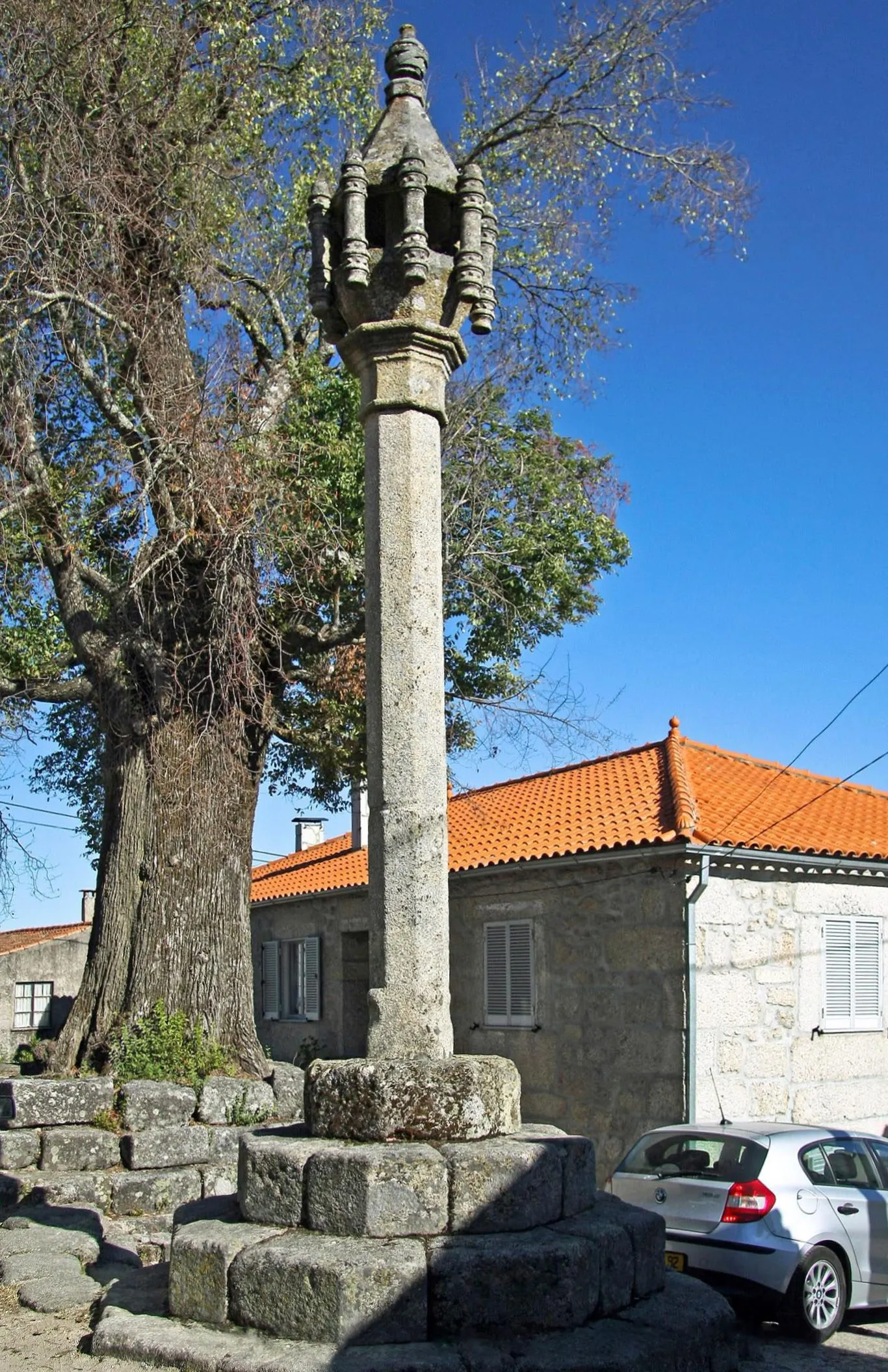
Beira Interior preserves some of the most elaborate pillories in the country, in towns that were seats of municipalities until the nineteenth century. This guide brings together those holding the classification of National Monument: Aguiar da Beira, Melo, Ranhados, Pinhel, Moreira de Rei, Rua, Freixo de Espada à Cinta and Fundão. For the function of the pillory, the Manueline reform of the charters and the general context, see the page on pillories; the pillory of Évora has its own text. The descriptions below follow the official record of the Património Cultural, I.P., unless otherwise indicated.
Aguiar da Beira
The Largo dos Monumentos Nacionais brings together the pillory, the crenellated tower and the crenellated fountain, three elements that Decree No. 8 330, of 17 August 1922, classified together as a “stretch of medieval architecture”. The pillory had already been classified individually by the decree of 16 June 1910, which is why the Atlas shows two records, one for the pillory and one for the stretch.
The town received a charter in 1120 (D. Teresa), confirmed in 1220, reformed in 1258 and renewed by D. Manuel in 1512; the pillory was probably erected following this last one, although some authors consider it earlier. It has a plinth of four octagonal steps, a smooth octagonal shaft girded by an iron ring and, at the top, a cage almost entirely open: an inverted truncated pyramid, another above it, a central colonnette and an armillary sphere in granite. Of the eight colonnettes the cage would have had, the record says no traces remain and doubts they ever existed.
The other two elements of the stretch are medieval. The tower, square in plan, is what remains of the castle ordered built by D. Dinis at the beginning of the fourteenth century; merlons crown it, and the four cannon-shaped gargoyles are a later addition. The fountain, with a well and basin and a crenellated terrace over the square, is Gothic, attributed to the fourteenth–fifteenth centuries; on the parapet of the terrace there is a barely legible inscription, “rui periz me fez” or “rui periz martiinz”.
Melo (Gouveia)
Melo was already a town in the thirteenth century and received a charter from D. Manuel in 1515, after which the pillory is said to have been raised beside the Town Hall and the district jail, which still stand and bear the coat of arms of the Melo family. Classified by Decree No. 2 167, of 31 December 1915, it rests on a plinth of four heavily worn steps. The smooth octagonal shaft, with a square base cut from the same block, supports a wide octagonal capital of six carved mouldings, bearing the shield of Portugal, and a pedestal with an armillary sphere and an iron cross.
Ranhados (Mêda)
The charter of Ranhados is from D. Dinis (1286), with a new charter from D. Manuel in 1512; the village belonged to the Templars and later became a commandery of the Order of Christ, and it was the seat of a municipality until 1836. The pillory, also classified in 1915, stands in front of the parish church. The shaft is a bundle of four colonnettes, each with a mask near the top, three of bearded men and one of a beardless face, and above them rests a crest of pinnacles with human and animal figures, among which a wolf’s or lion’s head. The record sees in it a Manueline work in its “wild” variant, with Romanesque references, and does not rule out that the faces represent the quaternary cycles, such as the seasons of the year.
Pinhel
In Pinhel the charter of D. Sancho I dates from 1209, was confirmed in 1217 and reformed by D. Dinis; the Manueline renewal of 1510 is the period to which the record attributes the pillory, in the Praça Sacadura Cabral. It rests on a plinth of five octagonal steps, has an octagonal shaft and a capital with a ring-and-neck band decorated with florets and quatrefoils, and ends in a cage of eight fluted colonnettes with a conical crowning and pinnacles. The record stresses its affinities with the pillory of Castelo Rodrigo and notes that, in the 1940s, consolidation works were carried out because of the gradual leaning of the structure. On the town, see also the castle of Pinhel and the castle of Castelo Rodrigo.
Moreira de Rei (Trancoso)
The first charter of Moreira de Rei dates from the twelfth century, of unknown date, and the Manueline new charter is from 1512. The municipality was abolished in 1855 and the village became a parish of Trancoso. The pillory, classified by Decree No. 21 354, of 13 June 1932, stands in the main square on six octagonal steps. The shaft is octagonal and smooth, the capital has graduated mouldings and the crown is a large cage with nine colonnettes, some of recent make, the result of restoration, and a pinnacle with an oval armillary sphere. The place name “de Rei” is explained by the record through the privileges of the first charter. See also the castle of Moreira de Rei and Trancoso.
Rua (Moimenta da Beira)
Rua was a fief of Egas Moniz and the seat of the municipality of Caria (or Caria and Rua), created by the Manueline charter of 1512; the municipality was abolished in 1855. The pillory, classified in 1915, is described in the record as the richest and most magnificent among those of the district of Viseu, comparable in this display only with those of Ranhados and of Vila Nova de Foz Côa. It rests on six octagonal steps; the cubical capital has four crowned royal heads at the corners, and the crown, monumental, combines four scallop shells, florets, four pinnacles at the corners and a central one with a series of winged heads. The record recalls possible readings, such as temporal and divine justice or an allusion to the Way of St James, but presents them as interpretations.
Freixo de Espada à Cinta
The Atlas identifies the pillory (in the parish of Freixo de Espada à Cinta and Mazouco) as a National Monument by Decree No. 8 228, of 4 July 1922; I did not find a descriptive record from the official register. A museum text on the town describes it as Manueline, with the shaft supporting a parallelepiped capital bearing the arms of Portugal and those of the town, and a crown on which appears an anthropomorphic figure topped by a plant motif and a small pine cone, and links the charter of 1512 to the town’s renewal. See the castle of Freixo de Espada à Cinta.
Fundão
The case of Fundão is the reverse of the previous ones. The town declared itself a town in 1580, when it sided with D. António, Prior of Crato, and then erected a pillory, jail and gallows, which was only made official in 1669; the municipality dates from 1747. The monument in the Largo do Município is a reconstruction of 1935 with some fragments of the original, destroyed in 1882: a tall plinth of square steps, an octagonal shaft, a Corinthian capital and a moulded pinecone with an iron cross over a globe. It was classified by the decree of 16 June 1910.
Reading the group
These eight pillories show the variants the national page describes: the cage of Aguiar da Beira, Pinhel and Moreira de Rei, the capital of Melo, and the crowns loaded with figures of Ranhados and Rua, with the armillary sphere still present in several. Almost all date back to the renewal of the charters by D. Manuel I, between 1510 and 1515, which explains the close dates. That of Fundão reminds us that classification also protects reconstructions.
The Atlas also lists the pillory of the town of Trancoso as a National Monument, outside this guide; several other pillories in the region, such as Carapito, Marialva or Alverca da Beira, are classified as Property of Public Interest. All stand in public space, without visiting hours.
Photograph by Vitor Oliveira from Torres Vedras, PORTUGAL, of 8 November 2011. Original on Wikimedia Commons, under CC BY-SA 2.0; resized and compressed for the web, without altering the composition.

Frequently asked questions
- Which pillories in Beira Interior are National Monuments?
- In this guide: Aguiar da Beira, Melo (Gouveia), Ranhados (Mêda), Pinhel, Moreira de Rei (Trancoso), Rua (Moimenta da Beira), Freixo de Espada à Cinta and Fundão. There are other pillories in the region with the lower category of Property of Public Interest, and the one in the town of Trancoso itself is also listed as a National Monument in the Atlas.
- What is a cage on a pillory?
- It is the open crown of some pillories, formed by small colonnettes that support a cap shaped like a truncated pyramid. The official records describe crowns of this type at Aguiar da Beira, Pinhel and Moreira de Rei.
- Is the pillory of Fundão original?
- In part. According to the official record, the present one is a 1935 reconstruction that reused some fragments of the original, which was destroyed in 1882.
- Why does the pillory of Aguiar da Beira have two classifications?
- It was individually classified by decree of 16 June 1910, and was classified again by Decree No. 8 330, of 17 August 1922, as part of a stretch of medieval architecture including the crenellated tower and the crenellated fountain.
Sources
- Património Cultural, I.P. — Pelourinho de Aguiar da Beira (70357)
- Património Cultural, I.P. — Trecho de arquitectura medieval constituído por pelourinho, torre ameada e fonte ameada (3719537)
- Património Cultural, I.P. — Pelourinho de Melo (70289)
- Património Cultural, I.P. — Pelourinho de Ranhados (71116)
- Património Cultural, I.P. — Pelourinho de Pinhel (70410)
- Património Cultural, I.P. — Pelourinho de Moreira de Rei (70419)
- Património Cultural, I.P. — Pelourinho de Rua (71218)
- Património Cultural, I.P. — Pelourinho do Fundão (69816)
- Projecto museográfico ArqueoHoje — textos sobre Freixo de Espada à Cinta
- Património Cultural, I.P. — Atlas do Património Imóvel (serviço ArcGIS, camada 1)
- Diário do Governo n.º 136, de 23 de junho de 1910 — decreto de 16 de junho de 1910
- Diário do Governo n.º 265, de 31 de dezembro de 1915 — Decreto n.º 2 167
- Diário do Governo n.º 133, de 4 de julho de 1922 — Decreto n.º 8 228
- Diário do Governo n.º 167, de 17 de agosto de 1922 — Decreto n.º 8 330
- Diário do Governo n.º 136, de 13 de junho de 1932 — Decreto n.º 21 354