Monuments
Bridge and Tower of Ucanha
Bridge and Tower of Ucanha, in Tarouca: a fortified medieval bridge over the Varosa, toll tower of the Salzedas estate, works of 1465 and National Monument.
- Location
- Ucanha, Tarouca, Viseu
- Built
- 2.ª metade do séc. XII (primeira configuração); reconstrução provável no séc. XIV; obras em 1465
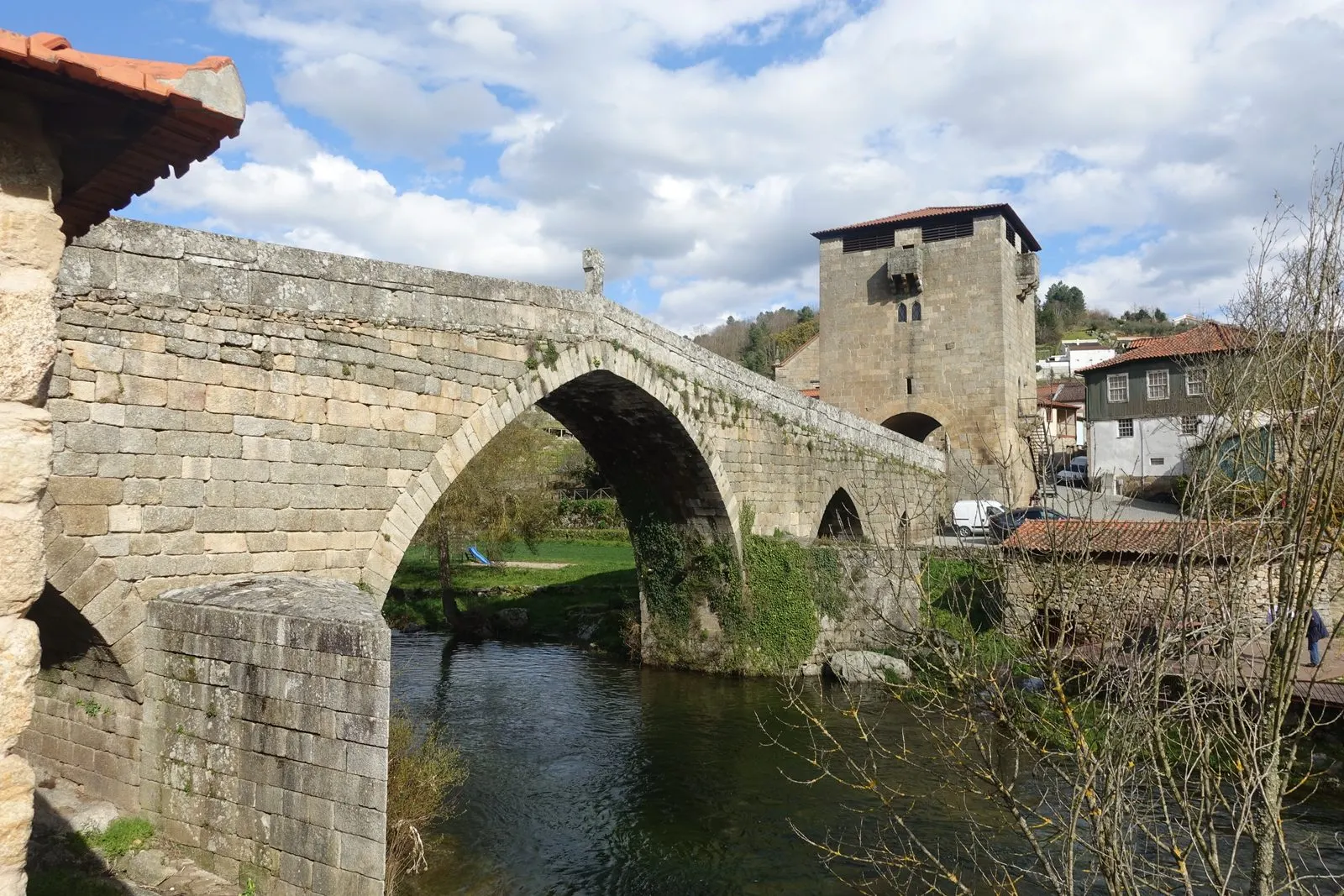
The Bridge and Tower of Ucanha crosses the Varosa river at the village of Ucanha, in the municipality of Tarouca. The complex combines a medieval granite bridge with a square tower raised at its head. It was there that one entered the estate of the Salzedas Monastery and where tolls were paid. Few works show as clearly how a bridge could be, at once, a passage, a seigneurial boundary and a source of income.
A bridge at the entrance to the estate
The national heritage register places the first configuration of the monument in the second half of the 12th century. At that time, this part of the territory belonged to the estate of the Salzedas Monastery. The bridge stood at the entrance to that territory, and the settlement that grew around it is referred to as Vila da Ponte.
The complex seen today, however, is later. The same register admits that the bridge and tower were possibly rebuilt in the 14th century. There is therefore no single construction date: the work resulted from several phases, and its exact chronology remains to be studied.
The bridge itself
The bridge has a double-trestle deck, a common solution in medieval bridges: its profile rises to the centre and descends towards the banks. It rests on five pointed arches. The central arch, with a much larger span, crosses the main bed of the Varosa, and its piers are the only ones reinforced with cutwaters.
Despite its age, it is not one of the country’s Roman bridges: the national register describes it as a medieval work, and the trestle form and pointed arches correspond to that building tradition.
The toll tower
What makes the complex unique is the tower associated with the bridge, built to protect the crossing and to control people and goods. In a territory with few river crossings, collecting tolls could be an important source of revenue, and it is in light of this levy that the national register explains the tower.
According to the national register, the tower stands on the side of the Tarouca monastery. It has a square plan and three storeys. On the top floor, all four faces have machicolated balconies with axial openings, which allowed the base of the building to be defended; there are also some arrow slits. Throughout the 14th century, several groups of residents tried to be exempted from the toll. According to the register, the monks of Salzedas managed to prevent all these attempts.
The works of 1465
In 1465, there is record of works on the complex carried out by Abbot D. Fernando of Salzedas, marked by a commemorative inscription. The national register notes that the extent of this work is unknown. The traces of the 15th-century campaign are not easy to identify, and the complex awaits a more complete study. For this reason, 1465 should be read as the date of a documented intervention, not as the date of construction of the tower.
Decline and restoration
The toll was abolished from 1504 onwards, and the monument lost much of its original function. The deck remained the main crossing in the area, but the tower fell into decay and served only as a warehouse. The trend was reversed only in the 1930s, when the Directorate-General for Buildings and National Monuments (DGEMN) restored the complex.
Classification
The national register identifies the monument as the Torre de Ucanha, with the alternative designation Ponte e Torre de Ucanha. It is classified as a National Monument by the Decree of 16 June 1910, published in the Diário do Governo no. 136, of 23 June 1910. In the same village, the Pelourinho da Ucanha has its own classification, as a Property of Public Interest, by Decree no. 23 122, of 11 October 1933; see also pillories.
Visiting the Varosa valley
The bridge is a public passage in the village, and the tower stands on Avenida Nova da Ponte, according to the national register. When consulted on 5 November 2026, we found no official information on visits to the interior of the tower. Expect to observe it from the outside and confirm any openings with the Municipality of Tarouca.
Ucanha pairs well with a visit to the two great Cistercian monasteries of the valley: Salzedas, lord of the estate where the bridge stood, and São João de Tarouca. The route is framed within the Cistercian routes in Portugal; for the region, see also Lamego.
Photograph by Joseolgon, of 16 March 2025. Original on Wikimedia Commons, under CC BY 4.0; resized and compressed for the web, without altering the composition.
Frequently asked questions
- What was the Ucanha tower used for?
- It controlled passage at the entrance to the estate of the Salzedas Monastery and was used to collect tolls from those crossing the Varosa river. It also had defensive features, such as machicolated balconies on the top floor.
- Was the tower built in 1465?
- The national register does not state this. It places the first configuration of the complex in the second half of the 12th century, and the reconstruction of the bridge and tower possibly in the 14th century. In 1465 there is record of works carried out by Abbot D. Fernando of Salzedas, marked by an inscription, but their extent is unknown.
- What is its classification?
- National Monument, under the designation «Torre de Ucanha», by the Decree of 16 June 1910 (Diário do Governo no. 136, of 23 June 1910). The register uses «Ponte e Torre de Ucanha» as an alternative designation.
- Is it a Roman bridge?
- No. The official sources consulted treat it as a medieval work: a trestle bridge with five pointed arches, associated with a monastic toll tower.
Sources
- Património Cultural, I.P. — Torre de Ucanha (70487)
- Património Cultural, I.P. — Atlas do Património Classificado e em Vias de Classificação
- Diário do Governo — Decreto de 16 de junho de 1910 (n.º 136, 23-06-1910)
- Diário do Governo — Decreto n.º 23 122, de 11 de outubro de 1933 (Pelourinho da Ucanha)
- Wikidata — Torre de Ucanha (Q9088953)
Keep exploring
Heritage nearby
More places to discover from here. Approximate straight-line distances, within 50 km.