Monuments
Monforte de Rio Livre Castle
Explore Chaves' Monforte de Rio Livre Castle: a 1312 keep, medieval walls and a Restoration half-bastion on the Trás-os-Montes border. National Monument.
- Location
- Monforte (Santo António de Monforte), Chaves, Vila Real
- Built
- Origem documentada no séc. XII; conjunto atual de finais do séc. XIII e primeira metade do séc. XIV (torre de menagem de 1312); meio baluarte após 1640
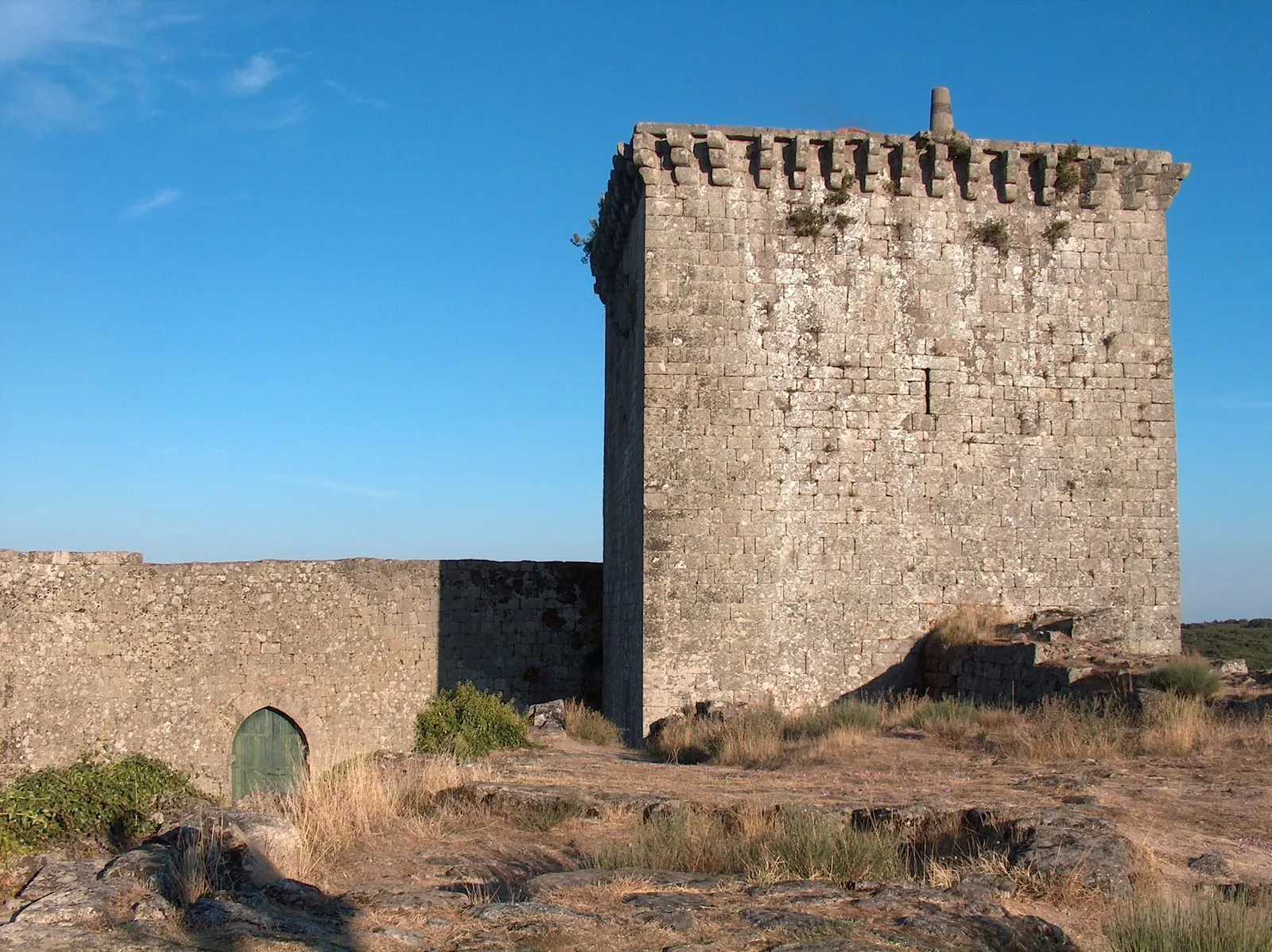
The Castle of Monforte de Rio Livre rises on a hill in the Serra do Brunheiro, next to the village of Monforte, in the municipality of Chaves, in the frontier lands of Trás-os-Montes. It is classified as a National Monument under the designation Castelo de Monforte. Of the medieval complex, the keep and the walled courtyard of the castle survive mainly. The town, which received its charter in 1273, began losing population from the end of the Middle Ages.
Origins
Some authors attribute a proto-historic origin to the settlement. The national register of the Património Cultural, I.P. treats this attribution as essentially traditional: so far no material remains have been identified that confirm it.
What is documented is later. In the 12th century a first fortification already existed, with a nobleman as the castle’s alcaide. Monforte de Rio Livre gained importance during the reign of King Afonso III, when it became the head of a territory. It was part of the same effort to organise the northern frontier that gave rise, for example, to the Castle of Montalegre.
The work of Afonso III and Dinis
Most of what is seen today dates from the late 13th century and the first half of the 14th century. King Afonso III granted Monforte its charter in 1273. The rebuilding of the fortress continued under King Dinis and was likely completed in the first half of the 14th century. At that time an alcaide is documented in the locality, and the urban area grew considerably.
The keep, built in 1312, is the main surviving element and the one that gives the castle its image. According to the national register:
- it has a square plan and three floors, with few openings, almost only narrow slit windows;
- one enters through a raised doorway with a round arch, facing the courtyard. A porch once sheltered it at an unknown date, and the marks of its roof can still be seen on the wall;
- on the lower floor there is a vaulted cistern, reached through an opening in the centre;
- the noble floor was the second, separated from the one below by a barrel vault, of which only the springers remain;
- a spiral staircase cut into the thickness of the wall led to the wall-walk. At the top, tripartite corbels supported a machicolated gallery that has disappeared.
The castle proper is a rectangular courtyard enclosed by walls of carefully dressed masonry, with two gates. The one on the south side has a round arch and a narrow opening. The western one, wider and with a pointed arch, was the main entrance and linked the stronghold to the medieval town. The town had its own enceinte with three gates, connected to that of the castle. This enceinte broke the symmetry of the complex in order to protect a small fountain. Within it stood the Casa da Câmara, the parish church and the chapel of Nossa Senhora do Prado, still standing in the 18th century.
Decline and the last military phase
The peak of King Dinis’s reign was short-lived. Less than a century later, King João I was obliged to establish in Monforte a sanctuary for fugitives, a sign of the difficulty in keeping the town populated. The barbican and the moat that surrounded the castle at the beginning of the 16th century probably date from this period.
King Manuel I renewed the charter, but could not halt the depopulation. The register cites the description by Duarte de Armas, who at the beginning of the 16th century counted only “ten or twelve households”, with the other houses demolished and reduced to ruins.
The last campaign of works came with the Restoration of Independence, from 1640 onwards. A half-bastion was then built over part of the area added at the end of the Middle Ages, along with other structures east of the keep. On this type of defence, see bastioned fortresses.
Twentieth-century interventions
At mid-20th century the castle underwent works, notably the concrete and tile roof of the keep, in 1962. In the 1990s improvements were made: an elementary archaeological campaign in the interior and the creation of a car park, among other things. The national register notes that the complex still awaits a comprehensive archaeological research project.
Classification and protection
The Castle of Monforte is a National Monument under Decree No. 37 728, published in the Diário do Governo, Series I, No. 4, of 5 January 1950. The decree describes it as “Castelo de Monforte, in the parish of Águas Frias”. The current register places it in the parish of Santo António de Monforte. The Atlas of Classified Heritage indicates that the property is under the responsibility of the Património Cultural, I.P., and does not indicate a specific special protection zone of its own. It is not part of any UNESCO inscription.
Planning the visit
The castle stands in an open area, at the top of the hill, and the national register refers to a car park next to the site. When consulted on 5 November 2026 we found no opening hours, tickets or visiting conditions published by an official source. Before going, please confirm access with the tourist office of Chaves.
The visit combines well with the historic centre of Chaves, its castle and the Roman bridge. For other frontier castles, consult the castles of Portugal and the North region.
Photograph by João Carvalho, dated 29 September 2005. Original on Wikimedia Commons, under CC BY-SA 3.0; resized and compressed for the web, without altering the composition.
Frequently asked questions
- Where is the Castle of Monforte de Rio Livre?
- In the municipality of Chaves, district of Vila Real, on a hill of the Serra do Brunheiro, next to the village of Monforte. The national register places it in the parish of Santo António de Monforte; the 1950 classification decree referred to the parish of Águas Frias.
- When was the keep built?
- According to the register of the Património Cultural, I.P., the keep was built in 1312, during the reign of King Dinis. It has a square plan and three floors, few openings, a raised doorway with a round arch, and a vaulted cistern on the lower floor.
- Is the castle classified?
- Yes. It is a National Monument under Decree No. 37 728, published in the Diário do Governo, Series I, No. 4, of 5 January 1950, under the designation Castelo de Monforte.
- Are there visiting hours?
- When consulted on 5 November 2026, we found no visiting hours or conditions published by an official source. The national register notes that a car park was provided at the site in the 1990s.
Sources
Keep exploring
Heritage nearby
More places to discover from here. Approximate straight-line distances, within 50 km.